The ATS Tell-All: What Actually Happens to Your Resume Before a Human Sees It
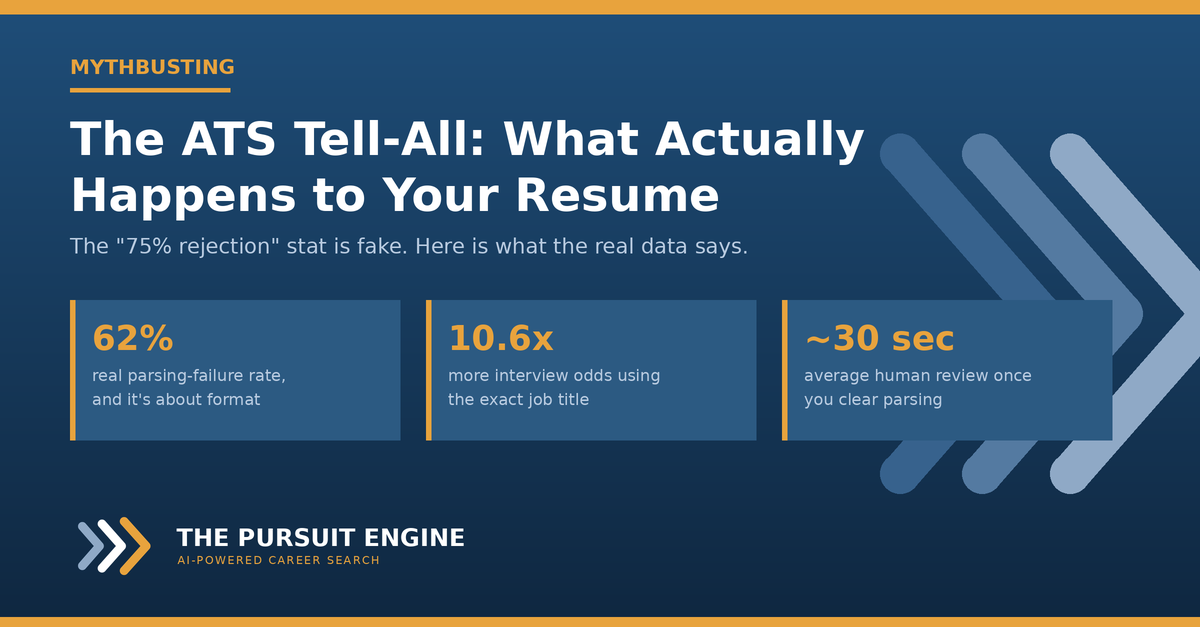
You have heard the number. "75 percent of resumes get rejected by the ATS before a human ever sees them."
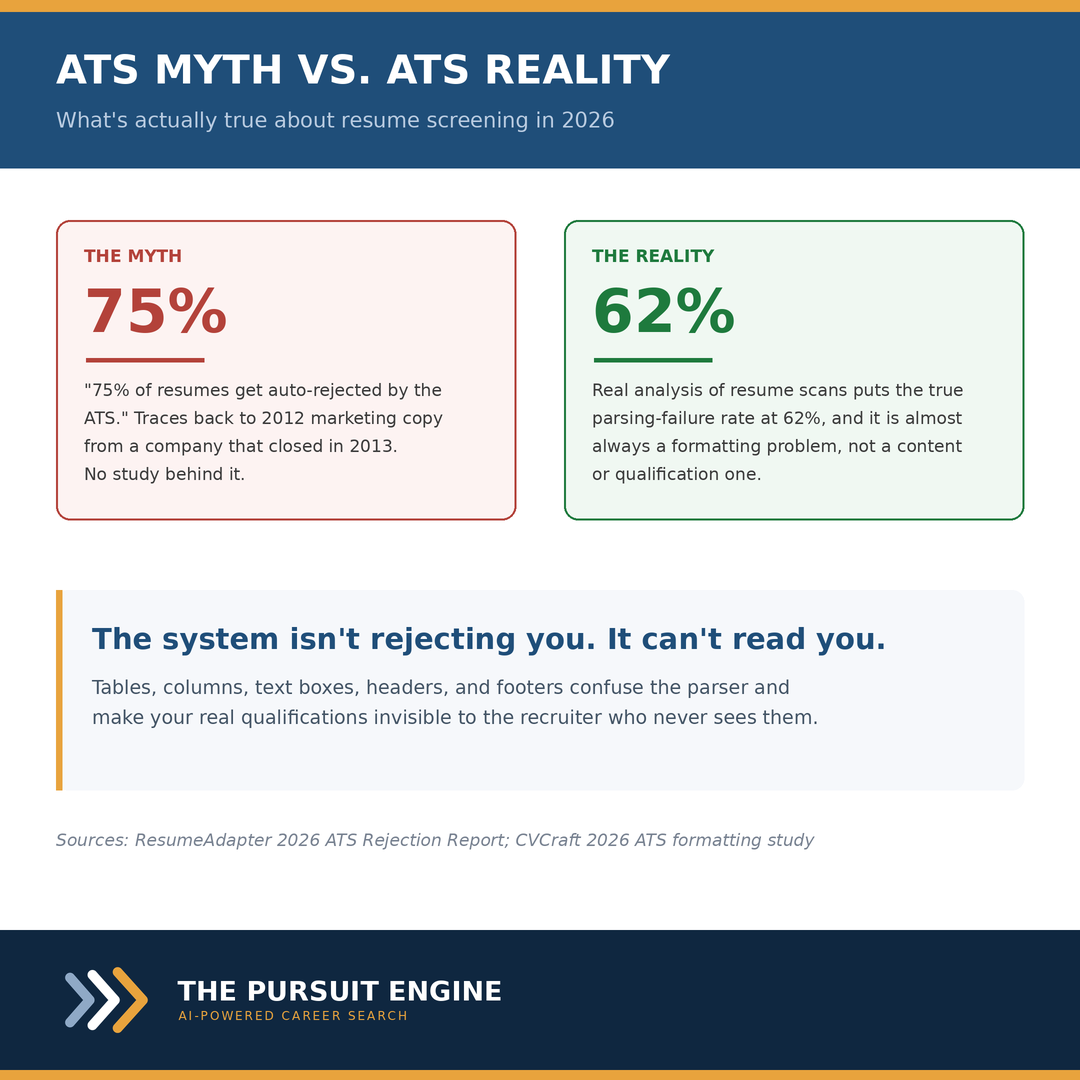
I want to start by telling you that number is fake. It traces back to marketing material from a resume-optimization company in 2012, a company that shut down the following year. No study ever produced it. And a 2025 survey of recruiters found 92 percent say their systems do not auto-reject resumes at all.
So why does the myth refuse to die? Because something real is happening, it just is not what the scary number implies. Let me walk you through what an ATS actually does, where resumes actually die, and what to do about it.
What an ATS actually is
An applicant tracking system is not a bouncer with a clipboard rejecting you on sight. It is a database. When you submit a resume, the software parses the document and tries to convert it into structured fields: name, contact info, job titles, employers, dates, skills, education.
That word "tries" is the whole story. If the parser cannot map your content into those fields cleanly, that content effectively disappears from what the recruiter sees, even though it is sitting right there on the page. Nobody rejected you. The system just could not read you.
98.8 percent of Fortune 500 companies run some form of ATS. Workday, Taleo, Greenhouse, iCIMS, and Lever cover most of the market between them. This is not a niche tool. It is the default front door for almost every mid-size and large employer.
Where resumes actually die
Independent analysis of real resume scans puts the true parsing-failure rate closer to 62 percent, and that number is not about content, it is about format.
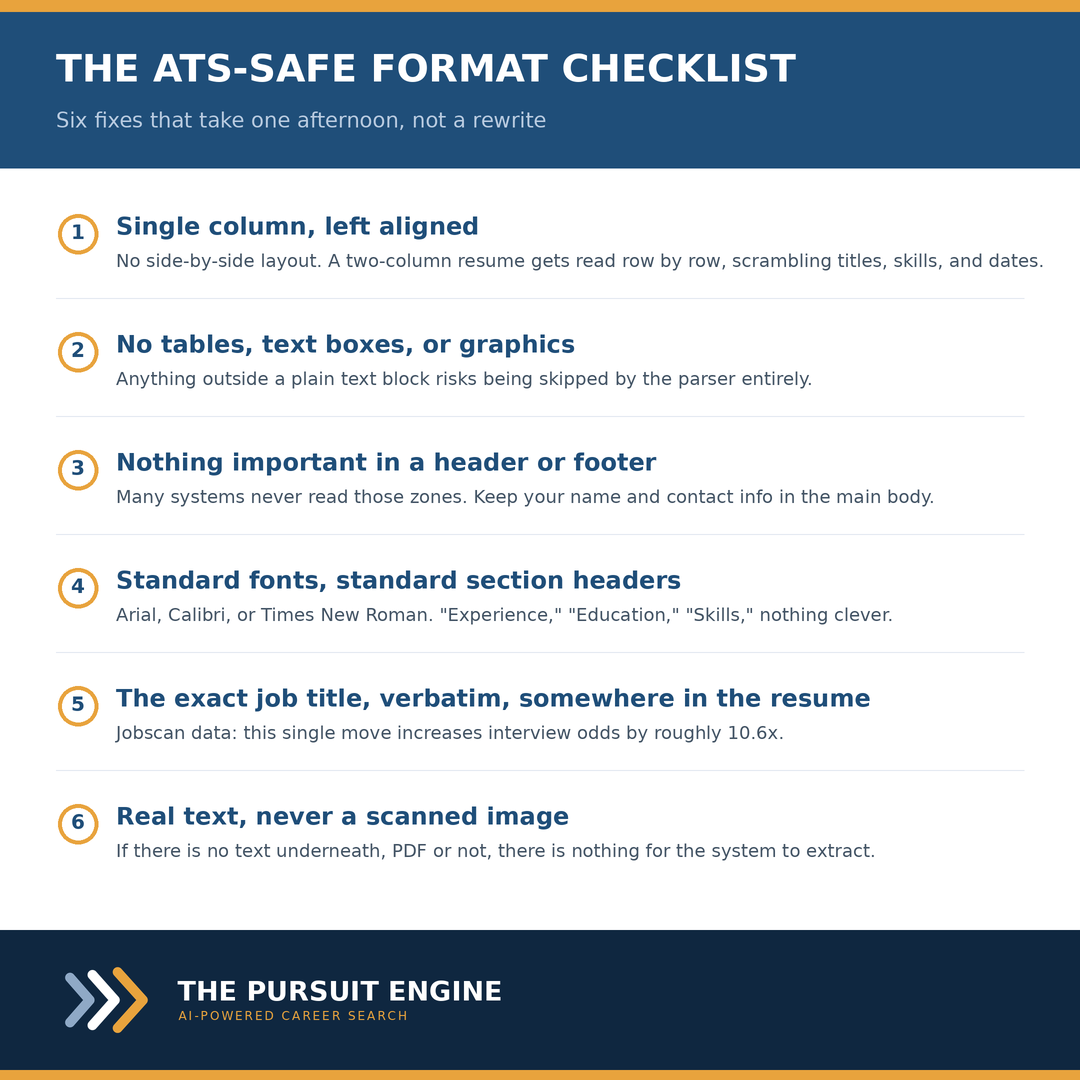
Tables, columns, text boxes, headers, footers, and graphics are the usual suspects. A two-column layout looks great to a human eye and gets read by a parser as row one, column one, then row one, column two, then row two, column one, in that order. Your job titles end up sitting next to the wrong skills. Your dates land between bullets from different roles. What you see as a clean design, the system sees as gibberish.
Contact information in a header or footer is a related trap. Many parsers never read those zones at all, so your name and phone number can be technically present and functionally invisible.
The fix is not complicated, but it is a real constraint on design: single column, left aligned, standard fonts, everything in the main body, nothing in a header, footer, table, or text box.
Curious what an ATS is actually doing with your resume right now?
Get 3 free roles →Both PDF and DOCX work with modern systems, the old advice that DOCX is always safer mostly applied to legacy ATS platforms that are less common now. What still kills a PDF is one made from a scanned image rather than real text, since there is no text underneath to extract at all.
Keywords are not a hack, they are the scoring mechanism
Here is the part most advice gets backwards. People treat keyword matching like a trick to game the system. It is not a trick. It is literally how the ranking works.
The ATS compares your resume's text against the job description and produces a match score. Higher overlap, higher rank in the queue the recruiter sees first. Jobscan's data on this is specific: including the exact job title from the posting, verbatim, increases your odds of an interview by roughly 10.6 times. That is the single highest-leverage line you can add to a resume, and it costs you nothing except reading the posting carefully.
Hard skills carry more weight than soft skills in this scoring, because hard skills are what a recruiter would type into a search themselves: specific software, methodologies, certifications, technical terms. "Team player" is not searchable. "Salesforce" is.
The most common failure I see is not a missing skill, it is a phrasing mismatch. You have the experience. You just described it differently than the posting did. If the job description says "stakeholder management" and your resume says "cross-functional collaboration," you may be saying the same thing and scoring as if you said nothing at all.
Even if you clear the ATS, you have seconds, not minutes
Getting parsed correctly and scoring well only gets you to the next gate: a human. And that human is fast. Recent studies put the real range between 17 and 46 seconds for an initial resume review, with the most cited figure landing around 30 seconds, not the old urban legend of six.
Thirty seconds is not nothing, but it means your first third has to work without explanation. If your strongest, most relevant accomplishment is buried on page two, it may as well not exist for that first pass.
What this actually means for you
Three things, in order of leverage.
One. Format for parsing before you format for beauty. A resume that looks slightly plainer and reads completely will always outperform a beautiful one that reads as noise.
Two. Mirror the posting's language deliberately, especially the exact job title and the hard skills named in the requirements, as long as you actually have them. This is not lying, it is translation. You already did the work, say it the way they are searching for it.
Three. Stop trusting the number, and start trusting the test. The honest way to know if your resume clears an ATS is to run it through a real parsing check, not to guess based on how it looks in Word.
That third one is exactly why I define "ATS-verified" as a specific claim in my own work, not a marketing phrase: it means I have parsed the document the way a system would and confirmed the content survives, not that I assume it does because the formatting looks clean.
The honest bottom line
The ATS is not your enemy, and it is not rejecting you out of spite. It is a flawed piece of software trying to do a hard job at scale, and most of what breaks in that process is fixable in an afternoon once you know where to look.
The myth version of this story makes you feel powerless against a black box. The real version hands you a checklist.
If you want a second set of eyes on whether your resume actually parses clean, send it to me. I will tell you what a system sees, not what I assume it sees.