Ghosted After Round Three? Here's What Was Actually Happening on Their Side
A client of mine made it through three rounds for a role she wanted badly. A recruiter screen, a hiring manager interview, a panel with the team. Then nothing. No rejection, no update, no answer to two polite follow-up emails. Just silence, for weeks.
She asked me what she'd done wrong in the panel. My honest answer: probably nothing. What was happening on the other side of that silence almost never has anything to do with the thirty minutes she spent in that room.
It runs in both directions, not just at you
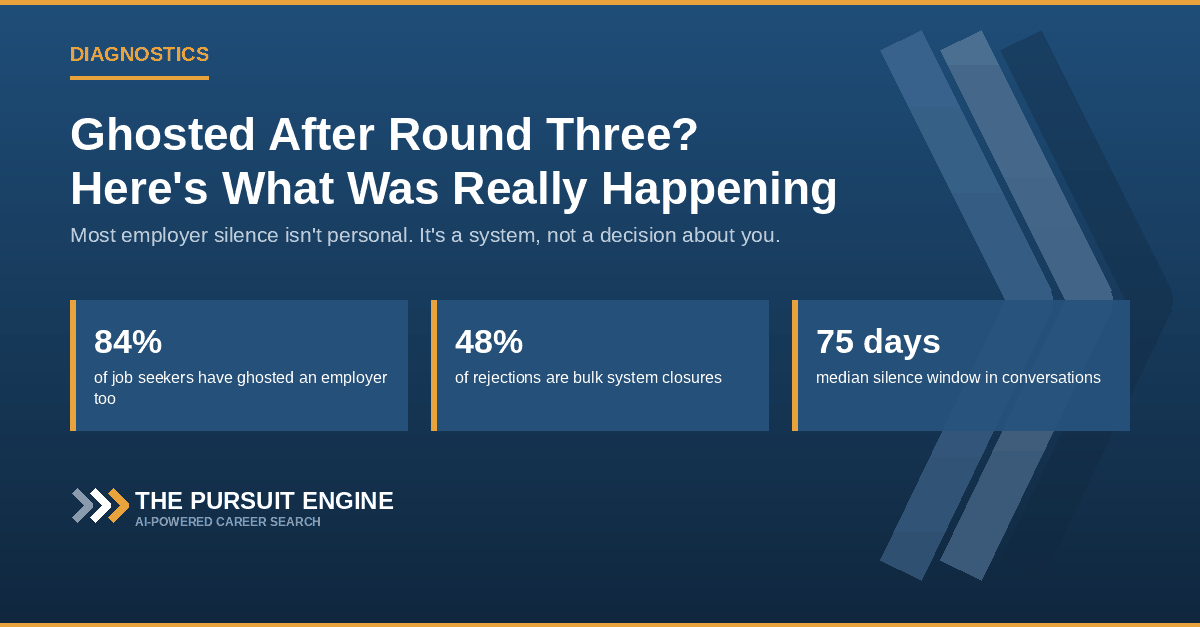
I wrote a few weeks ago about how 53% of job seekers report being ghosted by an employer in the past year, a three-year high. That number is real and it's rough to sit inside of. What I didn't say then is that candidates are doing the same thing right back: a Visier survey of 2,000 employees in the US and UK found 84% of job seekers have ghosted a potential or current employer in the past 18 months.
That doesn't make either side's silence okay. But it does mean this isn't a story about employers uniquely disrespecting candidates. The whole system's follow-up norms have quietly broken down, on both ends of the phone.
Most of what feels like ghosting isn't a person deciding to ignore you
This is the part that actually changed how I think about it. Pin, a candidate-communication platform, analyzed over 200,000 active candidate conversations between January 2024 and May 2026 and found that 48% of formal rejections are coded as bulk system closures, roles archived in a batch, not a hiring manager reading your file and passing. A separate Resume Genius survey of 625 hiring managers found 81% of them cited "still deciding if this candidate is the best option" as their reason for going quiet, not a firm no they were avoiding delivering.
Put those together and a lot of "ghosting" is really a decision that hasn't been made yet, sitting with a hiring manager who, per the same research, often rarely logs into the recruiting system the rejection would need to come from. From where you're sitting, an unmade decision and a rejection nobody sent look identical: silence. They are not the same thing.
Silence is not always a verdict. Sometimes it's just a decision that hasn't happened yet, sitting in someone's inbox instead of yours.
Tired of silence? Get three roles you know are actually being looked at.
Get 3 free roles →Where in the process it actually happens
Combined data from Greenhouse (2024) and iHire (2025) breaks down where in the hiring funnel candidates get ghosted most often:
| Stage | Share of ghosting events |
|---|---|
| After the initial recruiter call | 24% |
| After the hiring manager interview | 23% |
| After a homework or skills assignment | 12% |
| After the final interview | 12% |
| After multiple rounds | 11% |
| After a skills assessment | 9% |
| After salary negotiation | 4% |
Nearly half of all ghosting happens in the first two stages, before anyone has invested real time in you. The closer you get to an offer, the less likely you are to just disappear into silence, though it obviously still happens, and it stings more when it does.
How long is actually normal
Pin's same dataset found 72% of active candidate conversations on open roles go more than 30 days without recruiter follow-up, with a median silence window of 75 days. That's a genuinely long stretch, and it's worth knowing going in so a quiet month doesn't automatically read as bad news.
A reasonable way to handle it: one polite check-in around the two-week mark, brief and low-pressure, reiterating your interest and asking if there's an update. If three to four weeks pass with nothing after that, treat it as a soft no and put your energy elsewhere. Not because the door is definitely closed, sometimes it reopens later, but because your time is better spent on roles where something is actually moving.
The honest bottom line
The silence after an interview almost never means what it feels like it means in the moment. Sometimes it's a bulk closure, sometimes it's a decision stuck in someone's inbox, sometimes the role quietly went away and nobody circled back to tell you. What it usually isn't is a verdict on how you interviewed. Follow up once, give it a few weeks, and then let it go without carrying it as evidence against yourself.