11.7 Interviews, Not 3: What Five Years of Hiring Data Reveal About the Process You're Actually In
When I was interviewing after Lumen, I kept a running tally in my head. Round one, fine. Round two, fine. By round four I started assuming something was wrong, that a real process wouldn't need this many conversations before anyone made a decision. I was wrong about that, and I didn't have the data at the time to know it.
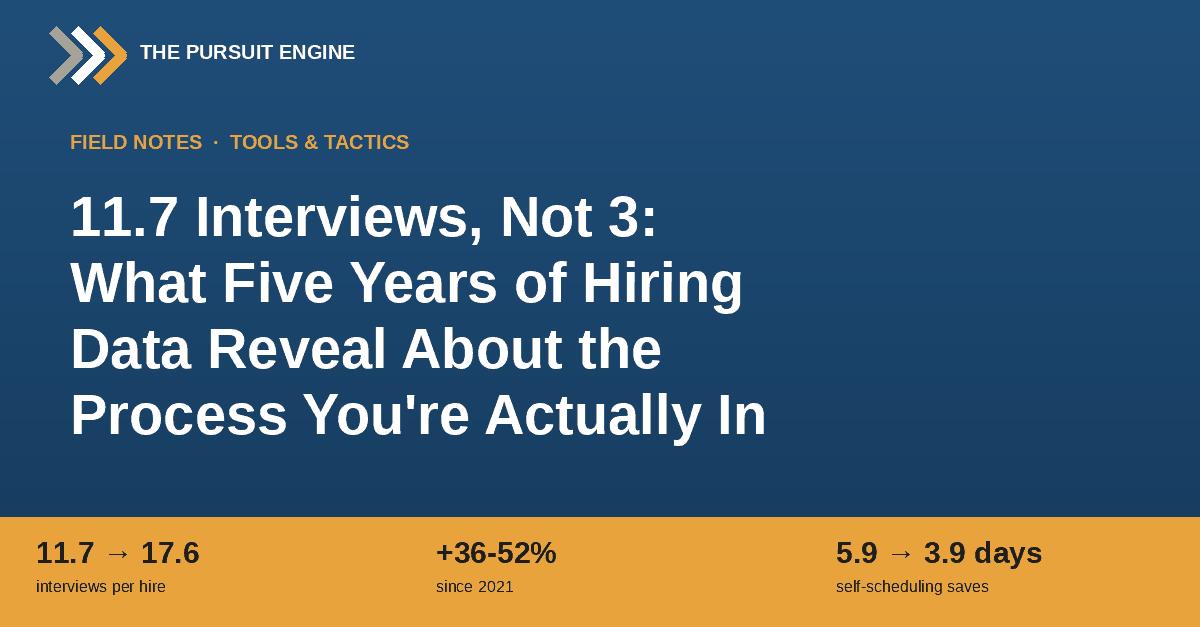
The data exists now, and it says round four is barely the midpoint. Ashby, a recruiting platform that tracks hiring activity across hundreds of companies, found that in the first quarter of 2026 it took an average of 11.7 interviews to produce one hire for a business role, and 17.6 for a technical role. In 2021, those numbers were roughly 8 and 11. That is a 36% to 52% increase in five years, and it did not happen because candidates got worse. It happened because the hiring process itself got longer, slower, and more cautious.
The process stretched. Nobody sent a memo about it.
Interviews per hire is only one way to see it. Greenhouse, which processes hiring activity for more than 6,000 North American organizations, found that by March 2026 the average job required 22.7 interviews and 12.3 interview hours per hire. Recruiters are also carrying far more of this alone: applications per recruiter are up 411.8% since 2022, while the number of recruiters per organization has fallen 55.6% over the same stretch. Fewer people are running a process that asks for more rounds than it used to. That combination is very likely why a search that once felt slow now feels, to a lot of candidates, like it is barely moving at all.
| Measure | 2021 | Q1 2026 |
|---|---|---|
| Interviews per business-role hire | ~8 | 11.7 |
| Interviews per technical-role hire | ~11 | 17.6 |
| Interview-to-offer rate, business roles | — | 10.4% |
| Interview-to-offer rate, technical roles | — | 7.3% |
A search that once felt slow now feels, to a lot of candidates, like it is barely moving at all. That is not a feeling. It is 36% to 52% more rounds than five years ago.
If round six still doesn't feel like progress, it might just be where you actually are.
Get 3 free verified roles →The one part of this you can actually control
Most of what drives this slowdown sits entirely outside a candidate's reach: headcount at the company, panel size, how many other finalists are in the mix. But there is one piece of the process that candidates have real influence over, and most people treat it as an afterthought: how fast they respond when someone asks them to schedule.
Ashby's Recruiting Coordination data, drawn from 2.8 million candidates and more than 5.1 million interview events, found that only about half of candidates return their availability within 24 hours of being asked. The median time from a scheduling request to the actual interview is 5 to 6 days. candidate.fyi's own 2025 platform data, covering roughly 258,000 scheduling signals, found that self-scheduling tools (the kind where you just pick an open slot instead of emailing back and forth) cut that gap to 3.9 days, against 5.9 days for manual coordination. Two full days, recovered, just by being ready to act the moment a request lands instead of letting it sit.
That gap matters more than it looks like on paper. A 2024 Cronofy survey of 12,000 candidates across seven countries found that 42% had walked away from a hiring process specifically because scheduling took too long. Slow scheduling is not a neutral delay that happens to you. It is a two-way failure point, and candidates who sit on a scheduling request for a week are contributing to the exact kind of drag that eventually costs them the role to someone faster, not necessarily someone better.
| Scheduling measure | Figure |
|---|---|
| Candidates returning availability within 24 hours | ~50% |
| Time to interview, manual back-and-forth | 5.9 days |
| Time to interview, self-scheduling link | 3.9 days |
| Candidates who left a process over slow scheduling | 42% |
Why the wait feels longer for panel rounds, because it is
One more pattern worth knowing before you read silence as rejection: panel interviews, the rounds with more than one interviewer in the room, take meaningfully longer to schedule than one-on-one rounds. Ashby's coordination data found that only 34% of panel interviews get scheduled within a day, compared to 54% for single-interviewer interviews. That is not about you. It is the simple math of getting several people's calendars to align instead of one. If a later round goes quiet for longer than an earlier one did, that is often exactly why.
And once you're actually in the room (or on the call)
One small, almost free thing still moves the needle at the end of each round: the follow-up. Robert Half's research on hiring manager preferences found that nine in ten managers surveyed said they genuinely appreciate being thanked by a promising candidate, and email was by far the preferred channel at 87%, ahead of a phone call, a handwritten note, or social media. Only 10% considered a text message an acceptable way to say it. Send it within 24 to 48 hours, keep it short, and send it by email. It costs five minutes and it is one of the only signals in this entire process that is entirely within your control, start to finish.
What to actually do with this
- Recalibrate what "normal" looks like. If you're several rounds in and nothing feels resolved, that is close to the median now, not a red flag. Business roles average 11.7 interviews before a hire happens; technical roles average 17.6.
- Treat every scheduling request like it has a clock on it. Reply within hours, not days. If you're offered a self-scheduling link instead of an email thread, use it, it is the fastest path back into a live conversation.
- Don't mistake a panel-round delay for a cold shoulder. Multi-interviewer rounds are mechanically slower to schedule. Give them more patience than you'd give a one-on-one before assuming the worst.
- Send the thank-you, every time, by email, within two days. It is cheap, it is appreciated by the overwhelming majority of hiring managers, and unlike almost everything else in this process, it is entirely up to you whether it happens.
The honest bottom line
I wish someone had told me, four rounds into my own search, that four rounds was still early. The process has gotten longer almost everywhere, not because candidates got weaker, but because companies are running leaner recruiting teams through more cautious, more drawn-out decisions. You can't shorten that process by wanting to. But you can control how fast you move the moment it's your turn, and that alone is worth more than it sounds like on a page like this one.