Low-Hire, Low-Fire: The Two Words That Explain Why This Market Feels Impossible
A client asked me something last week that stopped me for a second: "If the economy is supposedly fine, why does every single person I know who's searching feel like they're stuck in mud?" I didn't have a clean answer for her in the moment. I do now, and it's not a vibe, it's a real split in the data that most headlines skip past.
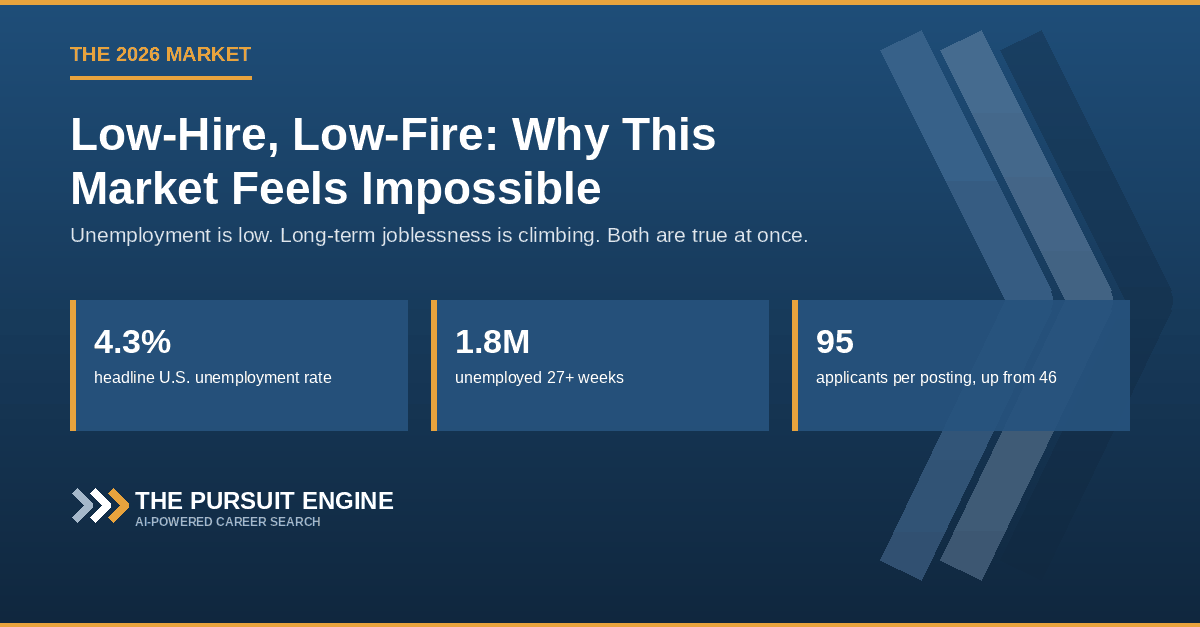
The unemployment rate is 4.3%. Historically, that's low. It's also, on its own, close to meaningless for anyone who's been searching for more than a couple of months, because it was never built to tell that story.
Two numbers, both true at the same time
Here's the split. As of August 2026, more than 25% of all unemployed Americans, roughly 1.8 million people, had been out of work 27 weeks or longer, per Bureau of Labor Statistics data cited by Marketplace and the National Employment Law Project. Michele Evermore of NELP called it a "historic position" for how many people are stuck long-term. The BLS doesn't even track duration past 27 weeks, so the real depth of that backlog, people at nine months, a year, longer, is undercounted by design.
A 4.3% headline rate and a rising long-term-unemployed population are not contradictory. They're describing two different things. The rate counts everyone out of work on a given week, a two-week gap and a fourteen-month gap look identical in that single number. It cannot tell you whether the unemployed population is churning quickly or getting stuck.
Right now, it's getting stuck. That's not a story about you doing something wrong. It's a story about a market that has nearly stopped churning, in either direction.
Want to know which openings near you are part of the real hiring, not the frozen kind?
Get 3 free roles →The market has a name: low-hire, low-fire
Labor economists have started calling this pattern "low-hire, low-fire." Employers have mostly stopped laying people off, which keeps the headline rate looking calm, but they've also mostly stopped opening new roles, which is why a search that would have taken eight weeks in 2021 can now take four or five months. Nobody's getting pushed out in large numbers. Almost nobody's getting pulled in, either.
An analysis by BambooHR covering 72 million job applications, over 1 million postings, and 6.5 million completed hires from January 2020 through March 2026 puts real numbers on that stall:
| Metric | 2021 | 2025 |
|---|---|---|
| Applicants per job posting | ~46 | ~95 |
| Annual hiring rate | 4.5% | 2.8% |
| Completed hires (2022 vs. 2025) | 1.34M | 1.05M |
| Share of fills that are internal moves | 51% | 62% |
Completed hires fell more than 20% even while the total employee population in that dataset grew from 30.8 million to 37.5 million. Companies are getting bigger without hiring more externally, largely by filling roles from inside. Offer-acceptance rates held steady in the mid-to-upper 70% range the whole time, which is the tell that this isn't candidates getting pickier or ghosting offers. It's employers being far more selective about who gets an offer at all.
What this actually means if you're the one searching
A few practical translations of "low-hire, low-fire" that changed how I coach clients through a stalled search:
- A long gap is a macro fact right now, not a character flaw. When over a quarter of the unemployed population has been searching six-plus months, a five-month search isn't a red flag on your resume, it's the median experience. Say that plainly if it comes up in an interview instead of over-apologizing for it.
- Internal mobility eating 62% of fills means fewer real external openings than the posting count suggests. A lot of what's posted externally is a formality around a role that's already spoken for internally. This is exactly why a referral or a warm internal contact matters more now than it did in a faster market, they can tell you whether a posting is actually open before you spend three hours tailoring an application to it.
- Rising applicants-per-posting (46 to 95) means untargeted volume is a worse strategy today than it was in 2021, not a better one. If nearly twice as many people are competing for each listing, the applications that stand out are the ones written for one specific role and one specific hiring manager, not the ones sent fastest to the most postings.
- Watch for the pockets where hiring is actually moving. The same BambooHR dataset shows posting volume jumped from a steady 15,600 to 16,800 a month across 2022 to 2025 up to over 20,000 in March 2026. Growth isn't zero, it's concentrated. Companies and sectors that are visibly still posting and filling roles are worth disproportionately more of your energy than the ones that quietly went dark.
The honest bottom line
The market isn't lying to you, but the single headline number is only telling you half of it. Low unemployment and a historic long-term-unemployed population can both be true, because they're measuring different things: how many people are out of work this week, versus how long the people who are out of work have been stuck. If you're deep in the second group, that's the market's shape right now, not a verdict on you. The people who move through it fastest aren't sending more applications, they're being more deliberate about fewer of them, and they're using every warm path they have to find out which roles are actually open before they invest in them.