Sunday Night, and the Real Math Behind Why This Search Feels Impossible
Sunday night is supposed to be for rest. If you're in the middle of a job search, it tends to show up as something else: a quiet dread around dinner time, a mental list of applications still unsent, a Monday that already feels heavy before it starts.
That feeling has a name. Surveys put the "Sunday Scaries" at anywhere from 61 to 70 percent of working adults, and for one in five, it's serious enough that they've considered quitting a job over it. If you're unemployed and searching, that same dread doesn't clock out on Friday. It just changes what it's about.
I wanted to know if the feeling matched the facts, or if this was just an unusually bad week in my head. So I went and pulled the actual 2026 numbers. They didn't make me feel better exactly, but they did make me feel less crazy, and there's a difference.
It is not in your head: the market actually flooded
If you've sent out fifty applications and heard almost nothing, here's what you're actually up against.
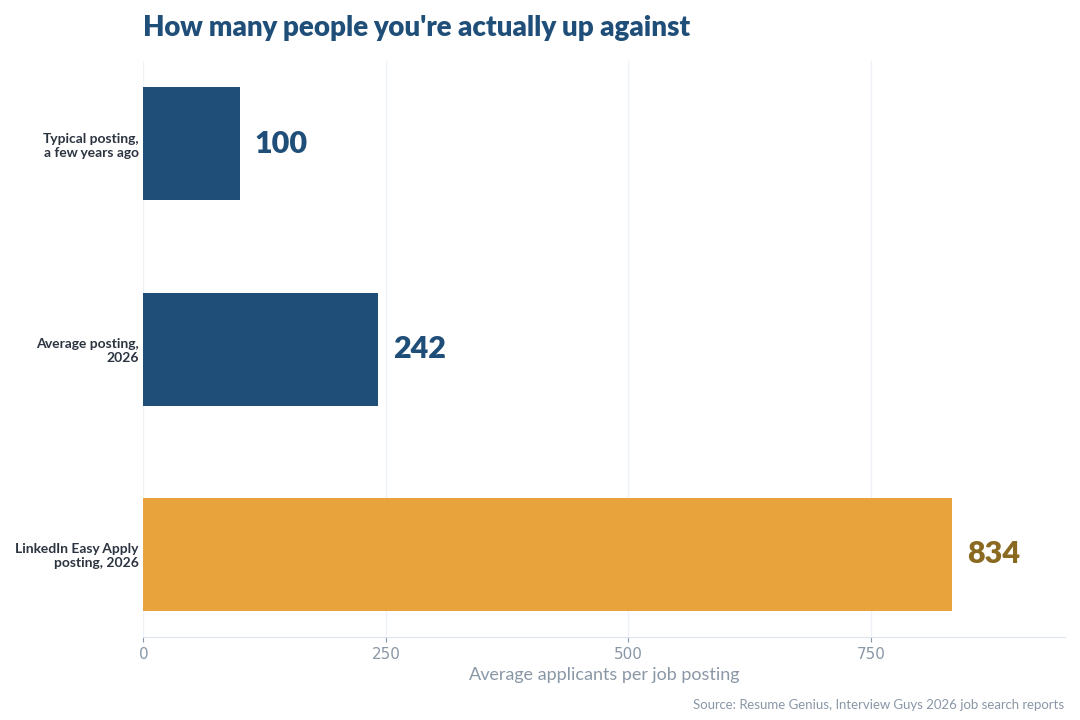
The average job posting in 2026 pulls somewhere between 180 and 250 applications, roughly double or more what a typical posting drew just a few years ago. On LinkedIn specifically, postings using the one-click "Easy Apply" button average 834 applications each. AI-assisted mass-apply tools made sending an application nearly free, for everyone, all at once, and the volume shows it.
The screening side scaled up to match. 87 percent of companies now use AI somewhere in their hiring process, and roughly 75 percent of resumes are reportedly discarded by that screening before a human ever opens them. The result: only 2 to 3 percent of applicants make it to an interview at all. Three years ago, your odds of getting a callback were meaningfully better than they are on the exact same effort today.
None of that is a reflection on you. It's a reflection on a denominator that quietly got ten times bigger while nobody was watching.
The silence has a name too, and it's getting worse
Somewhere on the other side of every one of those hundreds of applications is a real hiring manager, and a growing number of them are also going quiet.
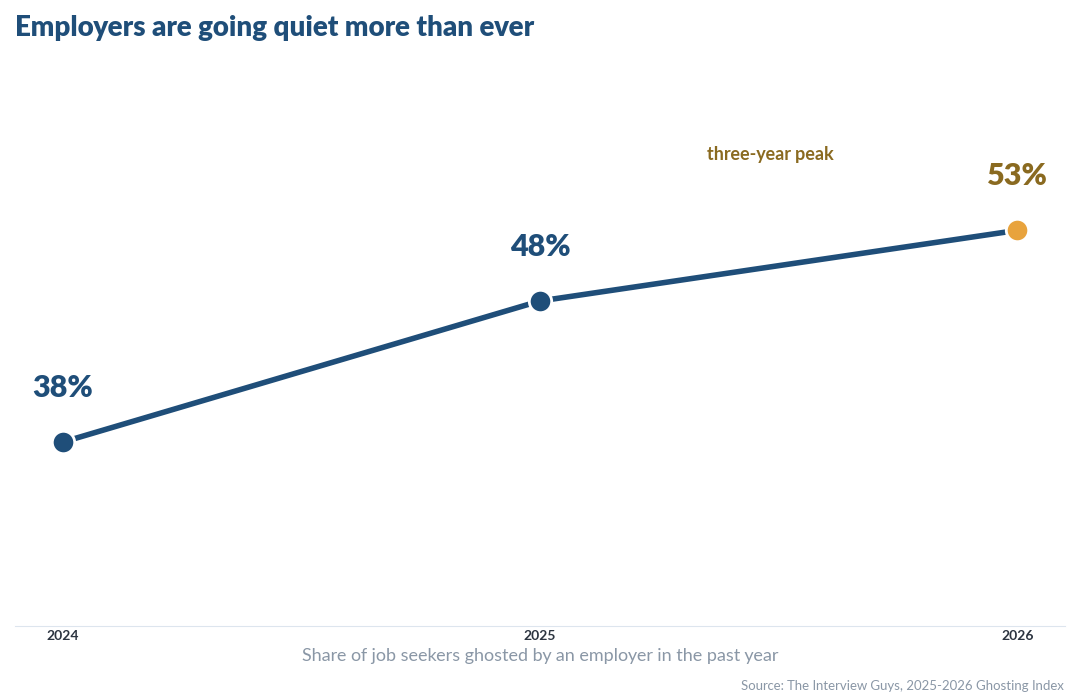
53 percent of job seekers report being ghosted by an employer in the past year as of 2026, a three-year peak, up from 48 percent in 2025 and 38 percent in 2024. It gets more personal further into the process: 61 percent of candidates report being ghosted specifically after an interview, meaning they showed up, answered every question, maybe completed a take-home assignment, and then heard nothing at all.
The expectation gap makes it sting more. 75 percent of applicants expect to hear back within two weeks, and 58 percent expect it within one. The actual median response time is 6.7 days when a response comes at all, which means the silence itself, not just the wait, has become a normal part of the process. Employer ghosting has roughly doubled since 2020. This is not a you problem. It's become the baseline.
What it actually costs, beyond the paycheck
The obvious cost of unemployment is the missing income. The costs that get talked about less are the ones that compound quietly in the background.
People who lose a job are roughly twice as likely to develop clinical depression as people who are still working, and the risk climbs the longer a search runs. A 2025 study of unemployed workers found 54.5 percent reporting depression symptoms, 50.9 percent reporting anxiety, and 38.9 percent reporting stress. This isn't fragility. Losing workplace structure, social contact, and a sense of forward motion all at once is genuinely hard on a person, and the research backs that up plainly.
Then there's the money that isn't the paycheck. COBRA continuation coverage runs about $560 a month for a single person in 2026, and often exceeds $1,500 a month for a family, which is $14,000 to $15,000 a year, paid post-tax, precisely while income has stopped.
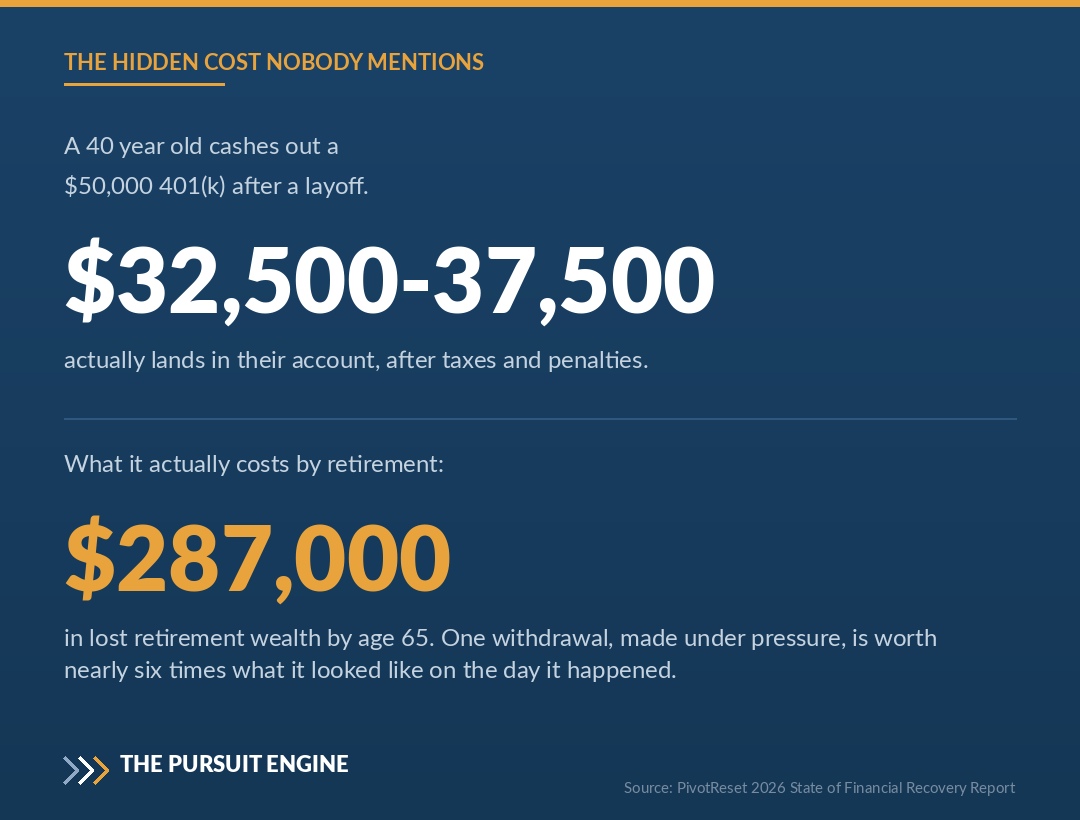
The one that surprised me most: about 1 in 5 laid-off workers cash out a 401(k) early to stay afloat. A 40 year old who withdraws $50,000 sees roughly $32,500 to $37,500 of it actually land in their account after taxes and penalties, and loses an estimated $287,000 in retirement wealth by age 65 in the process. It's a completely rational decision under pressure, made by someone trying to survive a month, that a spreadsheet decades out doesn't know how to weigh against a bill due Tuesday. That's exactly why it deserves to be said out loud instead of discovered later.
None of this is a character problem. It's what happens when a system that was already asking a lot of people quietly started asking for more.
Want your own head start this week, before the numbers pile up again?
Get 3 free roles →The one thing that still reliably works
Here's where the data actually turns hopeful, because inside all of this, one lever hasn't stopped working, and it's the same one I wrote about a few weeks ago in a piece on how long searches actually take: the split isn't optimist versus pessimist, it's structured versus unstructured, and a warm path in is the clearest structural advantage there is.
Referred candidates are hired at roughly 30 percent, compared to about 7 percent for candidates applying cold through a job board, a more than four-times difference on the exact same qualifications. Referrals account for 30 to 50 percent of all hires at companies with modern referral programs, and referred employees also show 48 percent higher retention and 33 percent stronger performance once hired. Employers aren't being difficult on purpose. They're managing risk in a market flooded with 834 applicants per posting, and a referral is the fastest, cheapest risk-reduction signal available to them.
That single fact reframes almost everything above it. The flood of applications, the ghosting, the silence, all of it describes what happens in the cold-apply lane. It does not have to describe your search specifically, and the way out of that lane isn't sending more applications into the same flood. It's finding the door that was already open.
So if tonight is one of the hard ones
However Sunday night has felt for you, here's the truth underneath all these numbers: this chapter is not permanent, and you are not doing this because something is wrong with you. You're doing it because the terrain actually changed, in ways that were never going to be visible from the inside of a single application.
What I do for a living now, running The Pursuit Engine, exists because of exactly this math. Every morning it verifies which roles are genuinely open, maps the warm path into each one before an application ever goes out, and builds what you need so the hardest part is already behind you before your alarm goes off. It doesn't make the market kinder. It just makes sure you're never standing in the cold-apply lane by default when a warmer one was available.
You do not have to carry this alone, and you do not have to guess at the numbers the way I did before I looked them up. Take five quiet minutes this week and see what a real head start feels like.