It's Been 12 Days Since Lumen. The National Data Says I'm Not Even a Sixth of the Way There.
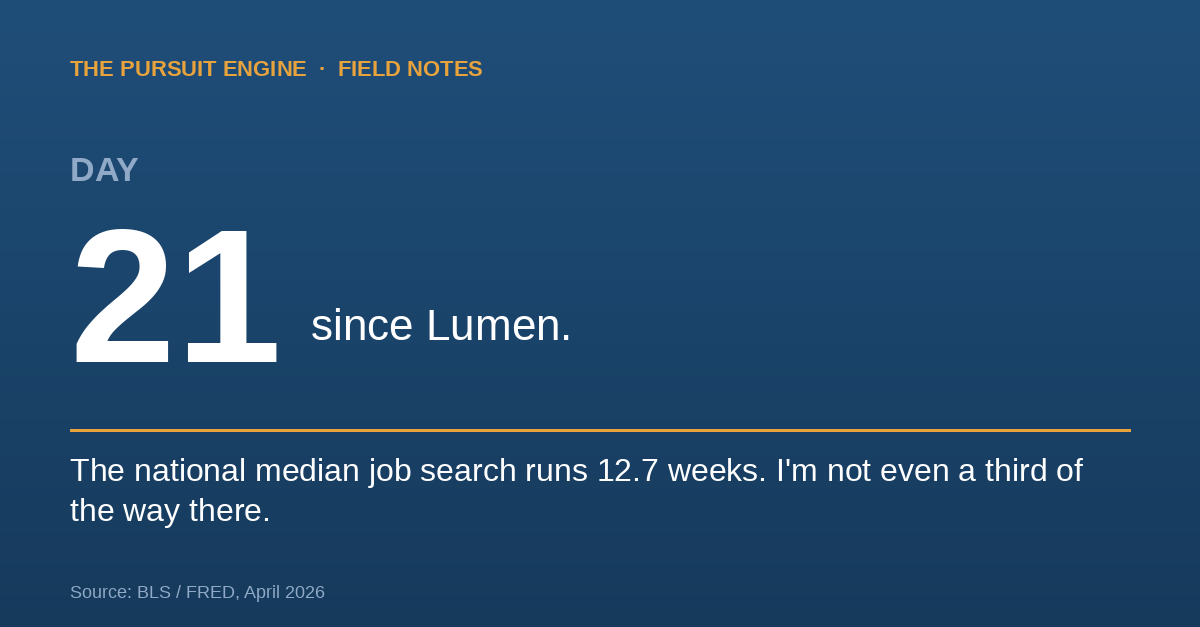
I was laid off from Lumen on July 10. Today is day 12.
If you had asked me on day one how long this would take, I would have said six to eight weeks. Maybe ten if the market was rough. That number was not based on anything. It was just the number that felt right, pulled from nowhere, the way most of us guess at things we have never had to measure.
Then I went and looked at the actual data. It stopped me cold.
The real numbers, not the ones we assume
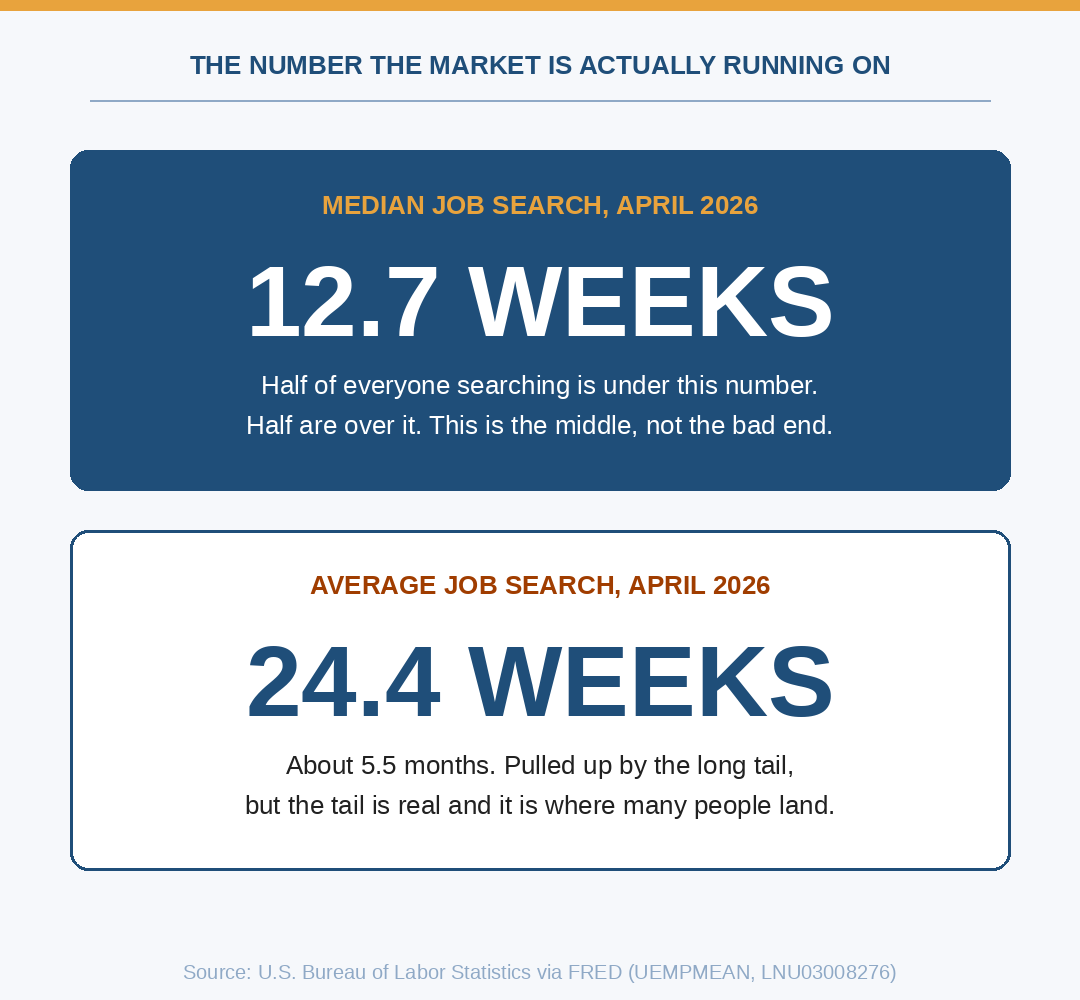
As of April 2026, the median length of unemployment in the United States is 12.7 weeks. Half of everyone actively looking is under that number, half are over it. That is just short of three months, and it is the middle of the pack, not the bad end.
The average is worse: 24.4 weeks, or about five and a half months. Averages get pulled up by the people stuck in long searches, so it is not the number a "typical" search lands on, but it tells you how far the tail stretches, and it tells you the tail is long.
Both of those are Bureau of Labor Statistics figures, current as of this writing. If your mental model of a job search is still "six weeks, eight at the outside," it is roughly two years out of date, and possibly longer if the last time you searched was before 2024.
Why this time is structurally different
This is not just "a tough market," the phrase we have used to describe every downturn since 2008. Something specific is happening in 2026, and it shows up clearly in the layoff data.
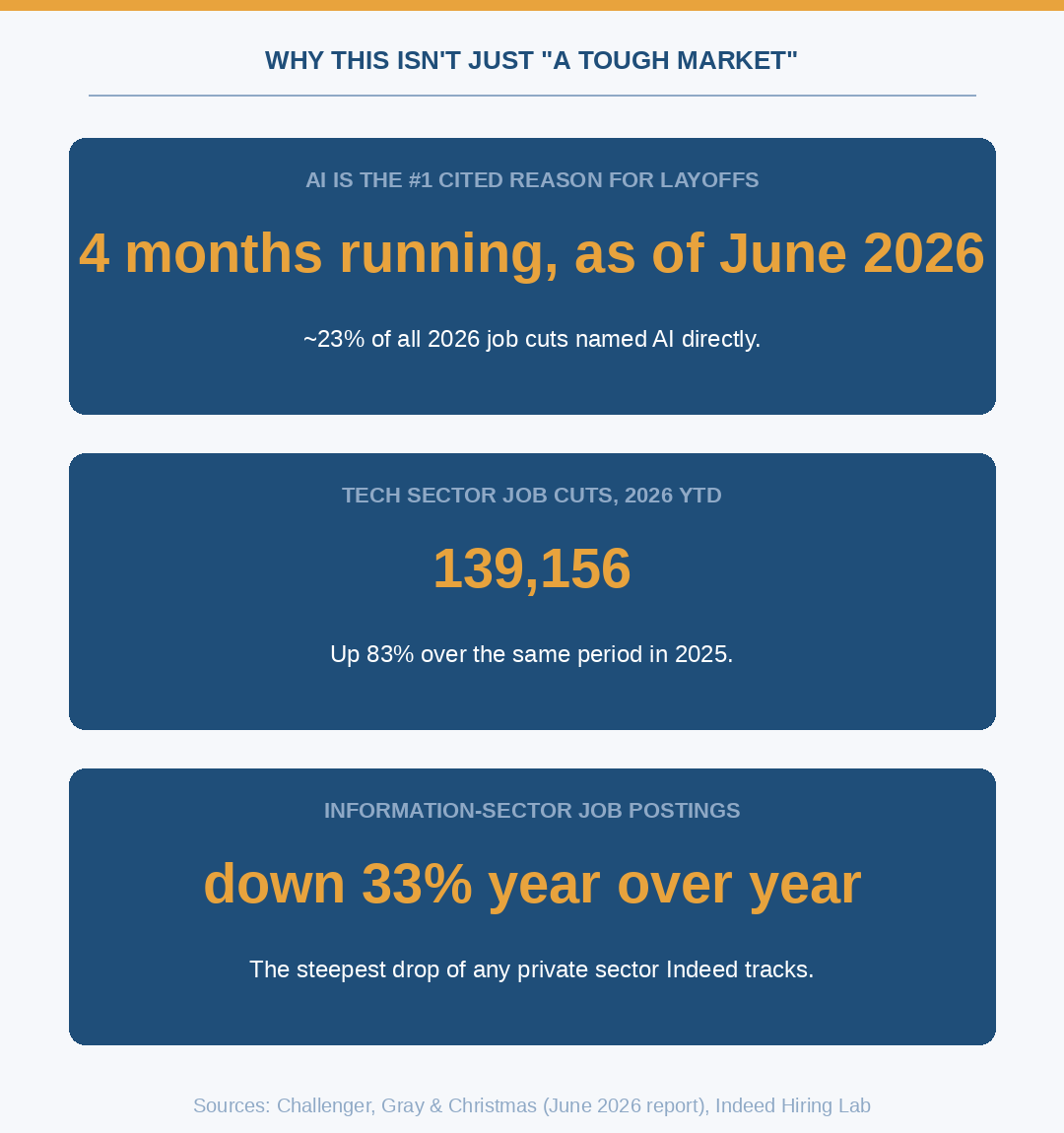
Challenger, Gray & Christmas, the outplacement firm that has tracked corporate layoffs since 1962, reported that artificial intelligence was the single leading cited reason for job cuts in June 2026, the fourth month in a row it has held that position. AI was named in roughly 101,700 job cut announcements through the first half of 2026, close to a quarter of every layoff announced this year.
Technology absorbed the worst of it. The sector logged 139,156 job cuts through June 2026, an 83 percent increase over the same period last year. If you are searching out of tech, or out of a tech-adjacent function inside a non-tech company, you are searching into the sector taking the hardest hit.
At the same time, hiring itself slowed down. Indeed's Hiring Lab, which tracks live job postings across the platform, found that postings in the information sector, which includes most tech roles, are down 33 percent year over year, the steepest drop of any private sector they track. Professional and business services postings are down 20 percent. Other services, down 21 percent.
Companies are not doing mass layoffs the way they did in 2020, but they are also not backfilling, not expanding, and not competing for talent the way they were as recently as 2022. Labor economists have started calling it a "low hire, low fire" market.
Want to know where your own timeline actually stands, not just the averages?
Get 3 free roles →None of that means the market is closed. It means it moves slower and it screens harder, and pretending otherwise just makes the wait feel like a personal failure instead of what it actually is: a measurable shift in the terrain.
"Time to fill" is not "time to land." Know the difference.
Here is a distinction that gets flattened in almost every article about hiring timelines, and it matters.
When a company reports its "time to fill," that is how long it takes them to close one requisition, on average around 44 to 45 days nationally in 2026, according to SHRM's benchmarking data. It varies by field: manufacturing closes fastest, around 31 days. IT runs about 33. Financial services and government both stretch past 40.
That is the employer's clock. It is not your clock.
Your clock started running the day you were let go, or the day you decided to leave, and it does not stop until you accept an offer. Along the way you are competing for a seat inside dozens of those employer clocks running in parallel, most of which you will not get, some of which will silently expire without ever telling you they closed, and only one of which needs to land.
The 12.7-week median and 24.4-week average above are your clock, the candidate's clock, not the employer's. They already account for every one of those employer processes stacking up against each other in your search. That is why they run longer than any single company's stated "time to fill." It is not one clock. It is however many it takes.
The real split isn't optimist versus pessimist. It's structured versus unstructured.
Here is the part I think gets missed, and it is the part that actually matters if you are in the middle of this right now.
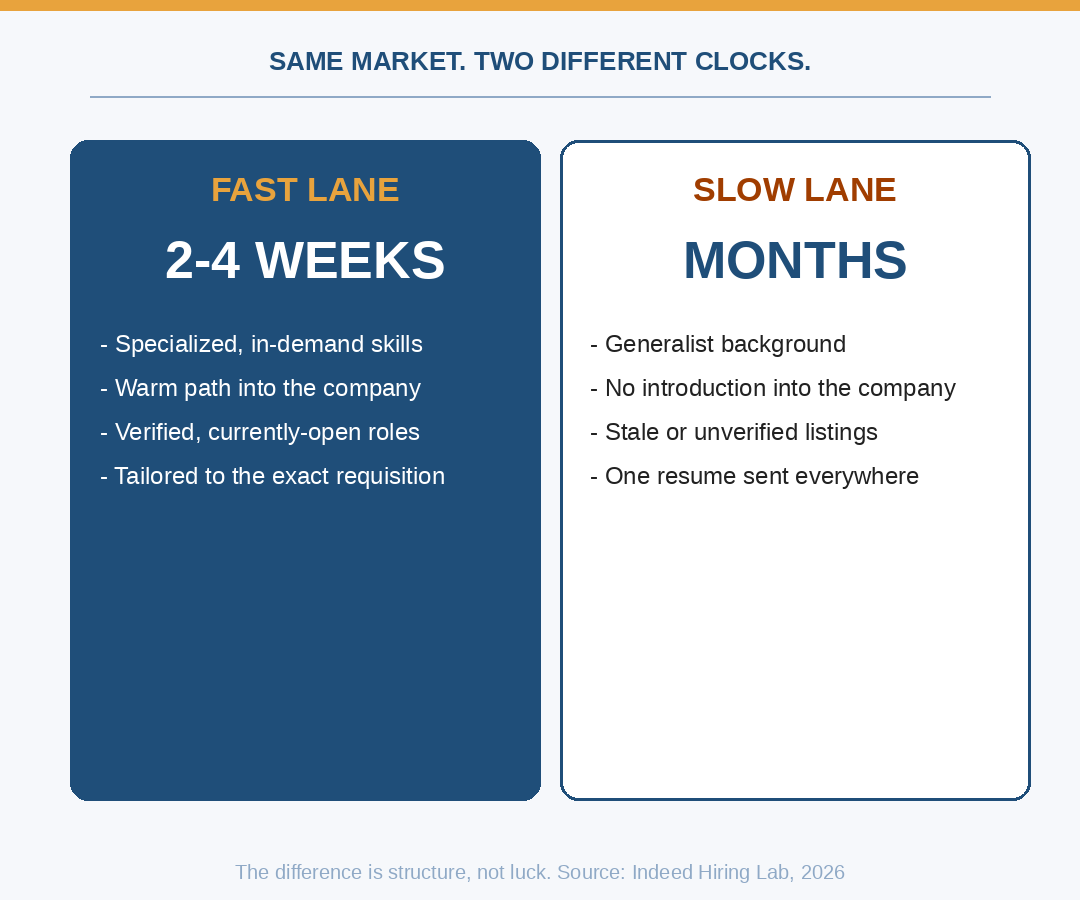
Indeed's own researchers have flagged a growing split inside these numbers. Senior candidates with current, in-demand, specialized skills, the kind of experience that is hard to backfill and easy to verify, are closing offers in two to four weeks. Generalists without recent hands-on work in a hot specialty, or without a warm path into the hiring team, are the ones stretching into the months-long tail that drags the average up to 24.4 weeks.
Same market. Same macro headwinds. Two completely different outcomes, and the difference is not luck and it is not talent. It is structure.
An unstructured search means applying broadly through job boards, waiting on algorithmic screening you cannot see or influence, and hoping a recruiter notices your resume in a stack of four hundred. A structured search means every application is going in through a verified, currently open requisition, tailored specifically to the words that requisition uses, with a warm introduction into the company wherever one exists, tracked and followed up on a real cadence instead of sent into the void.
The macro data describes the slow lane. It does not have to describe your search.
What this actually means for you, and what I built because of it
I am not telling you any of this to make twelve days feel like nothing, or to make the weeks ahead feel heavier than they already do. I am telling you this because I spent years in enterprise sales measuring pipelines for a living, and an unmeasured pipeline is the single easiest way to feel like you are failing at something you are actually just early in.
If the national median is 12.7 weeks, about 89 days, and I am 12 days in, I am not behind. I am still in the opening stretch, exactly where the data says I should be, and I only know that because I looked at the real number instead of the guess I made up on day one.
That is also, not coincidentally, why I built The Pursuit Engine the way I did. Every morning, it finds roles in a client's specific lane, confirms each one is genuinely open right now rather than a stale or fictional listing, builds a resume and cover letter tailored to that exact requisition's language, and maps who they already know inside the company before a single application goes out. That is the fast lane, built on purpose, running against a market that defaults everyone else into the slow one.
The value of that is not abstract. If the average search runs 24.4 weeks and a structured one closes meaningfully faster, the math is straightforward: weeks of runway, weeks of income, weeks of not wondering, saved. That is what you are actually buying. Not hope. Time.
Twelve days in, I know my number now. I would rather you know yours than guess, the way I did on day one.