The Recruiter DM That Wasn't: A Real Transcript
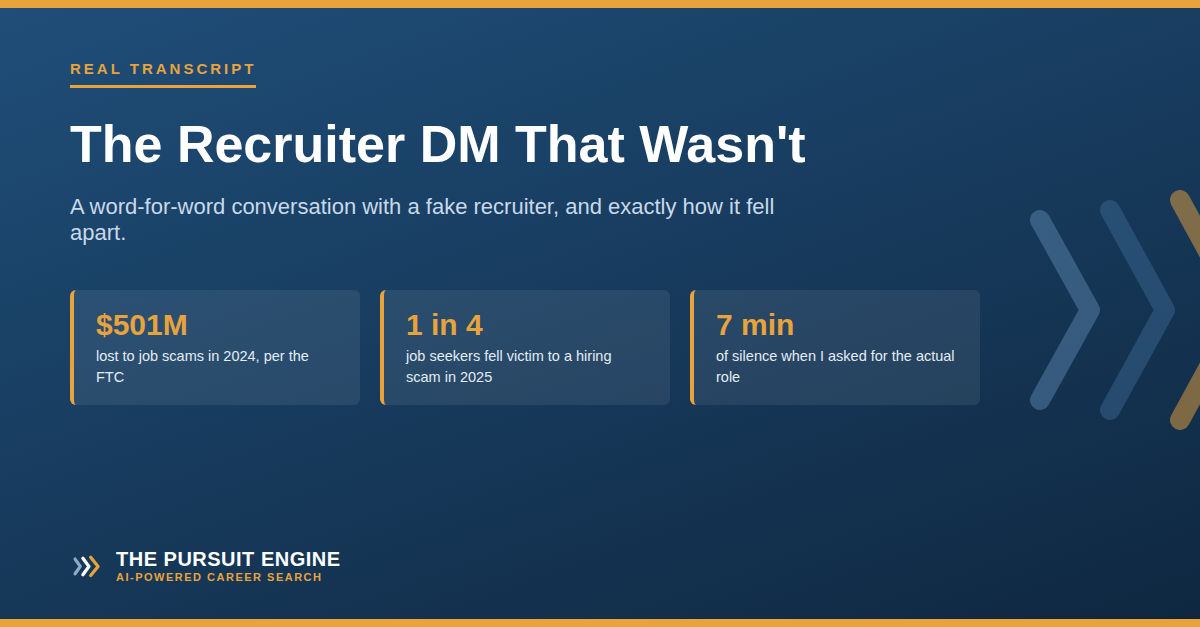
If you're job searching right now, you are a target. Not eventually, right now, today. Job scams and fake-recruiter outreach have exploded over the last few years, and most people have no idea how close it's already gotten to them. I got a fresh example of exactly what that looks like this week, and instead of just warning you about it in the abstract, I want to show you the actual conversation, word for word, so you know precisely what to watch for. Then I'll show you the data behind why this matters, and exactly what to do if it happens to you.
The numbers are not small. The FTC reports that consumer losses to job scams nearly tripled between 2020 and 2024, from $90 million to $501 million, and Q4 2025 alone brought in over 25,000 reports totaling $150.4 million in losses, a median of $2,000 per victim. A 2025 survey found that 1 in 4 job seekers fell victim to a hiring scam, and 6 in 10 encountered either a fake job posting or a fraudulent recruiter contact. The Better Business Bureau found that of everyone who ran into a job scam, 1 in 3 actually lost money, at a median of $1,500. And on LinkedIn specifically, one individual alone has documented and gotten over 55,000 fake job listings removed. This isn't a rare, unlucky encounter. It's a volume business, and job seekers are the product.
Before I responded the first time, I checked her profile. Over 500 connections, 697 followers, looked established at a glance. But the profile itself was written entirely in Portuguese, describing a customer service background, nothing resembling recruiting or resume expertise. That alone should slow anyone down: if you can't verify what's there, you can't confirm the pitch.
Here's exactly how the conversation went, start to finish.
The transcript
Why this doesn't hold up
A few things here don't survive basic scrutiny, and they're worth knowing because they show up in scripts like this one over and over.
She critiqued a document she never received, and never once acknowledged it. I never sent a resume. When I pointed that out directly, she didn't correct course, she pivoted. "Your resume" became "I reviewed your profile," a completely different document, offered as if the swap wouldn't be noticed. When I named the swap outright, she doubled down: "I believe your profile should reflect what is in your resume." Two documents were now one, whenever it was convenient.
She liked being called out, then didn't answer for it. When I told her plainly that she was selling something with no actual value, since there was no resume to critique in the first place, she reacted to that message with a thumbs up. Then she kept going as if nothing had landed.
The technical critique was invented. STAR is an interview-answer framework. It has nothing to do with resume formatting, and "ELITE method" isn't a real, established framework I or anyone I know has ever encountered. It's jargon, built to sound like expertise to someone who won't check.
Want messages from real recruiters instead of ones you have to fact-check?
Get 3 free roles →No role was ever named. Not once, across the entire exchange, despite me asking directly twice. A recruiter working a real requisition leads with it: the company, the title, the comp range, something concrete. This never happened.
When I asked the direct question, there was nothing behind the script. "Bottom line, you don't actually have a role?" got silence for seven minutes, then "Nah you know." No defense, no pivot, no attempt to salvage it. That's the moment the whole thing fell apart, because a real recruiter has an actual answer to that question.
The pattern, and what to do about it
What made this one recognizable, fast, is that it followed a script: generic praise, a level-check with no context, a request for a resume before any real conversation had happened, then manufactured critique of a document she was never given, dressed up in invented methodology. If you're in this exact sequence, ask for the role directly. If it doesn't come, you already have your answer.
If it happens to you: stop responding and don't send a resume, ID, or any financial information. Report the profile to LinkedIn directly (Report or Block, right from their profile) so it gets flagged for review, which is the path I'm taking with this one rather than continuing to engage her. If any money or personal data already changed hands, report it at reportfraud.ftc.gov and to your bank the same day. And whenever a "recruiter" reaches out cold, verify independently: search the company's own careers page for the role they claim to be filling before you give them anything.
I'm not sharing this to be unkind. I'm sharing it because I built The Pursuit Engine after watching too many people, myself included at one point, waste real energy and real hope on exchanges like this one. You deserve better than a script.