The Job Isn't Real. The Paycheck Screenshot Is.
A woman in Minnesota lost $65,000. A man in Ohio lost $100,000. A woman in Texas lost $140,000. None of them wired money to a stranger who asked for it outright, that version of the scam, most people know to walk away from by now. What actually happened to them started small: a text message, a few dollars for liking a YouTube video, a tidy little dashboard that showed their "earnings" ticking up. By the time any of them realized nothing about it was real, they'd already put their own money in to "unlock" funds they thought they'd already made.
This is called a task-based job scam, and it is quietly becoming the fastest-growing version of employment fraud out there. If you're job searching right now, there's a real chance one has already landed in your texts.
How it actually works
Task-based scams don't look like the job scams most people were warned about. There's no upfront fee, no request for your Social Security number on day one, nothing that trips the usual alarm. The Better Business Bureau's 2026 employment scams study lays out the pattern clearly, and it's worth knowing step by step, because each individual step feels small and reasonable in the moment.
- An unsolicited text message offers easy money for simple work, often "flexible remote job" or "part-time online task" framing, from a number you don't recognize.
- The conversation moves off-platform, usually to WhatsApp or Telegram, within the first exchange or two.
- You're hired almost immediately, sometimes after a token "interview" that's really just a formality.
- You're given a gamified dashboard that tracks tasks completed and money "earned," things like rating products, subscribing to channels, or approving ad images.
- Small payouts land first, real money, small amounts, specifically so the whole thing feels legitimate.
- The trap springs on withdrawal. You're told your balance is real but "locked," and you have to deposit your own money to release it.
One BBB Scam Tracker victim described the experience this way: "Almost child-like stuff. I wondered whether the system was connected to gambling or something." That's not an accident. The small early payouts, the leveling-up dashboard, the sense of a balance you've already earned sitting just out of reach, all of it is built the same way a slot machine is built. It's designed to make walking away feel like giving up money you already have, instead of what it actually is: the only way to stop losing more.
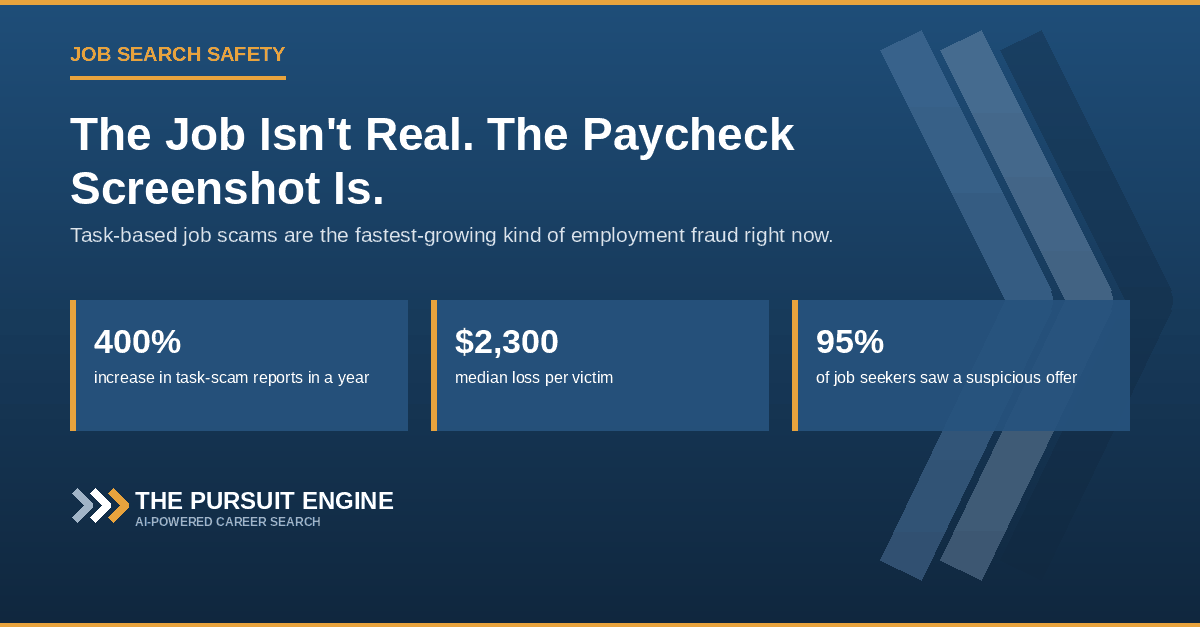
Median loss in task-based job scams reached $2,300 in 2025. The FTC recorded a 400% increase in task scam reports in a single year.
Every role in a Pursuit Engine package is verified before it ever reaches you. See what that looks like.
Get 3 free roles →Why this is exploding right now
Job scams generally have been climbing for years. The FTC's own numbers show reported losses growing from roughly $90 million in 2020 to about $501 million in 2024, a jump that tracks almost exactly with how much harder and longer job searches have gotten over the same period. But task-based scams specifically are the newer, faster-growing piece of that picture: the FTC recorded a 400% increase in task scam reports in 2024 alone, and the BBB's 2026 update found the median loss per victim reached $2,300 in 2025, with nearly 680 of that year's employment scam reports fitting the task-scam pattern specifically. Half of all employment scam reports to the BBB listed text messages as the way the scam first reached them, and Consumer Reports separately found text-based scams overall rose 50% in 2025.
Here's the number that should worry every job seeker reading this, not just the people who've already lost money: according to an FTC data study, only about 4.8% of victims of mass-market fraud ever report it to the BBB or a government agency. The public totals, as large as they already are, are almost certainly a fraction of what's actually happening.
You are not paranoid. Almost everyone is seeing this.
If it feels like scam attempts have been landing in your inbox and texts more than usual this year, that's not your imagination. A Monster survey of 884 U.S. full-time workers, fielded in March 2026, found that 95% of job seekers have encountered a suspicious job offer, and 98% believe today's job market makes people more vulnerable to fraud than it used to. More strikingly, 53% said they'd been directly targeted by a scam attempt themselves, not just seen one float by.
The same survey asked people where the scams actually reached them. Email led at 65%, followed closely by text messages at 63% and unsolicited recruiter outreach at 56%. Job boards themselves accounted for 51%, and professional networking platforms like LinkedIn for 43%. In other words: nowhere in a job search is fully safe from this, which is exactly why knowing the specific red flags matters more than trying to avoid any one channel.
| Red flag (among job seekers who hit a scam) | How often it showed up |
|---|---|
| Communication happened only by text or chat | 63% |
| Offered the position with no interview at all | 57% |
| Promised high pay for minimal work | 57% |
| Poor grammar or a suspicious email address | 51% |
| Recruiter couldn't clearly identify the hiring company | 43% |
The fallout isn't only financial, either. Among job seekers who ran into a scam, Monster found 33% lost real time chasing a fake opportunity, 24% reported ongoing stress or anxiety afterward, and 23% ended up sharing personal information before they realized what was happening. Nearly half, 48%, said the experience left them more skeptical of legitimate outreach too, which has its own quiet cost: a real recruiter with a real role now has to work harder to be believed.
What actually protects you
- Any request to pay to "unlock" money you already earned is disqualifying, full stop. Legitimate employers never ask you to deposit your own money before you can access pay, ever, for any reason.
- Treat a move to WhatsApp or Telegram as a signal, not a convenience. Real hiring processes stay on company email or an applicant tracking system. A sudden push to a personal messaging app early in the conversation is one of the clearest tells in the BBB's data.
- Be more suspicious of an offer with no real interview, not less relieved by it. It's tempting to read an instant offer as a good sign. In this data, 57% of scam encounters involved exactly that.
- Google the exact phrasing of unusual outreach. Task-scam scripts get reused thousands of times; a search often surfaces other people describing the identical message within seconds.
- Report it even if you didn't lose money. With only 4.8% of victims reporting, under-reporting is part of why this keeps working. reportfraud.ftc.gov and ic3.gov both take a few minutes and feed the pattern data that helps flag repeat offenders.
Where this fits with what I tell clients
I built The Pursuit Engine after my own layoff from Lumen, at a point where I was applying to anything that looked plausible because the volume itself felt like progress. Scammers count on exactly that instinct, the sense that you can't afford to pass on anything that might be real. Every role that goes into a client's package here gets verified before it reaches them, specifically so that energy goes toward roles that are actually open, at actual companies, instead of toward a dashboard that was never going to pay out.
If something about an offer feels slightly off, that instinct is worth trusting. In this data, the people who got hurt weren't careless, they were busy, hopeful, and moving fast in a search that already asks a lot of them. That's not a character flaw. It's exactly the state scammers are built to target.