The 8.4-Second Screen: Why "Old School" Tactics Are Making a Comeback
A client told me she'd applied to over 200 roles in six weeks and heard back from four. She wasn't exaggerating, and she wasn't doing anything wrong. She was doing exactly what most job search advice still tells people to do: apply, apply, apply. The math behind why that alone isn't working anymore is worth putting in front of you plainly.
The number that explains the silence
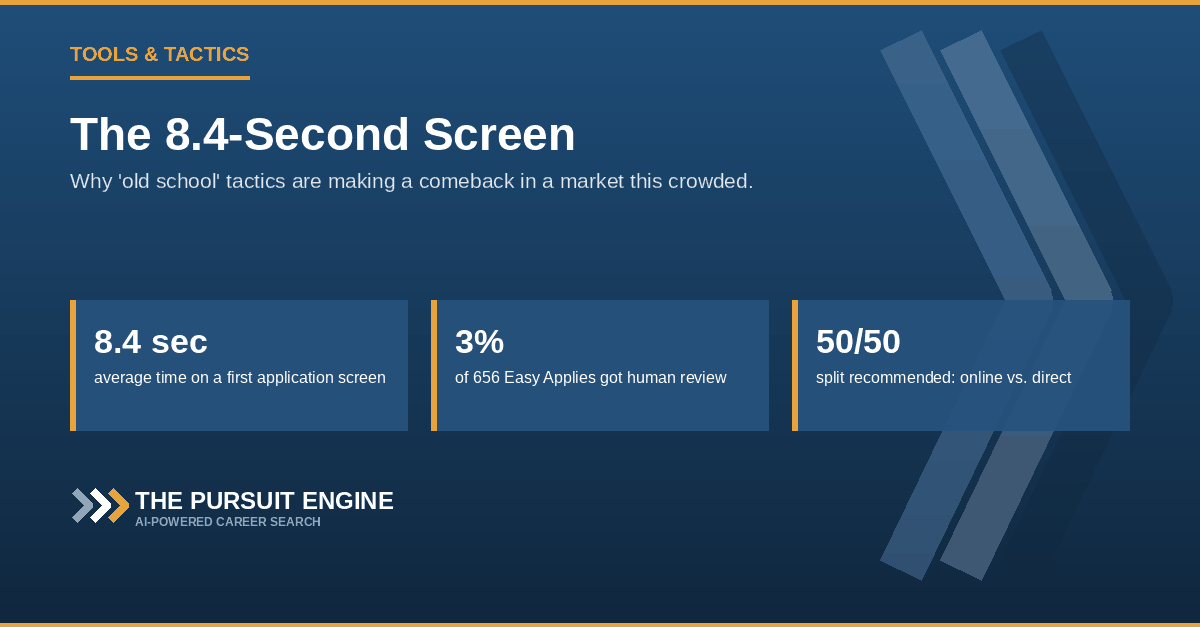
Recruiters spend an average of 8.4 seconds on the first screen of an application, according to recruiting-workflow research. That's not a careless number, it's a structural one: with dozens or hundreds of applications stacked against a single posting, the first pass is a scan, not a read. It's looking for role-relevant language and a clean, obvious structure. It is not looking for the full shape of your career, and it will not find it in 8.4 seconds no matter how strong that career is.
One job seeker profiled by Dice.com put a number on what that means in practice: 656 applications sent through LinkedIn's Easy Apply in 30 days. Human review on roughly 3% of them. That's over 20 applications a day for a month, and fewer than 20 people actually looked at the results.
Volume was a reasonable strategy when a posting drew forty applicants. It stops being one somewhere around a thousand.
Want a package built for one real, verified role instead of another Easy Apply blast?
Get 3 free roles →The openings that never get to 8.4 seconds at all
Here's the part that actually changed how I coach a stalled search. A career coach named Chris Scherting, also profiled by Dice.com, found he could surface roughly one unadvertised opening a week purely through direct outreach and conversation, roles that were never posted publicly, and so were never sitting in a queue of a thousand other applications getting an 8.4-second glance. No ATS screen. No keyword scan. Just a conversation that turned into a role before it ever became a posting.
That's the actual case for "old school" tactics in 2026. It isn't nostalgia, and it isn't a rejection of the online system. It's that a meaningful share of real openings never enter the system you're competing inside of at all. Career coach Brian Young put it plainly: "the reality is that your job search is going to take longer if applying online is all you're doing." He recommends something close to a 50/50 split, roughly half your effort online, half through more direct, personal channels.
What the 50/50 split actually looks like
None of this means abandon online applications, they're still how most roles get filled. It means treating them as one channel among a few, not the whole strategy. A few of the specific tactics worth putting real time behind alongside your online applications:
- Target local and mid-size companies specifically. They pull a fraction of the applicant volume that a large, well-known employer does for the same role, which means your application is far more likely to actually get read rather than scanned.
- Reach out to former colleagues and classmates directly, not just connect on LinkedIn. A short, specific message asking about their company or team surfaces information, and sometimes openings, that never make it to a public posting.
- Consider a mailed resume for a role you want but haven't seen posted. It sounds old-fashioned because it is, which is exactly why it still stands out: almost nobody else is doing it, so it doesn't compete with a thousand other applications for 8.4 seconds of attention.
- Prepare for the conversations this actually produces. Networking and direct outreach tend to lead to real conversations faster than online applications do, so it's worth having interview answers ready using the STAR method (Situation, Task, Action, Result) before you need them, not after a call catches you off guard.
The honest bottom line
The client I mentioned at the start wasn't failing at her search. She was running one whole strategy in a system built to skim past most of what enters it in under nine seconds. The fix wasn't applying to more roles, it was putting some of that same energy into the roles that never show up in a search at all, the ones a real conversation finds a week before a posting ever would. Online applications still matter. They just were never supposed to be the entire plan.