The Anxiety Loop: Why Feeling Stuck Makes the Search Longer, and What Breaks It
A client texted me at 11pm a few weeks ago: "I think I'm the problem." She'd sent out forty applications that week. Heard back from one, a rejection. She wasn't asking for advice. She was asking, in a roundabout way, whether something was wrong with her. It wasn't. What she was describing has a name in the research, and a shape, and, more usefully, a documented way out of it.
The number that made me stop scrolling
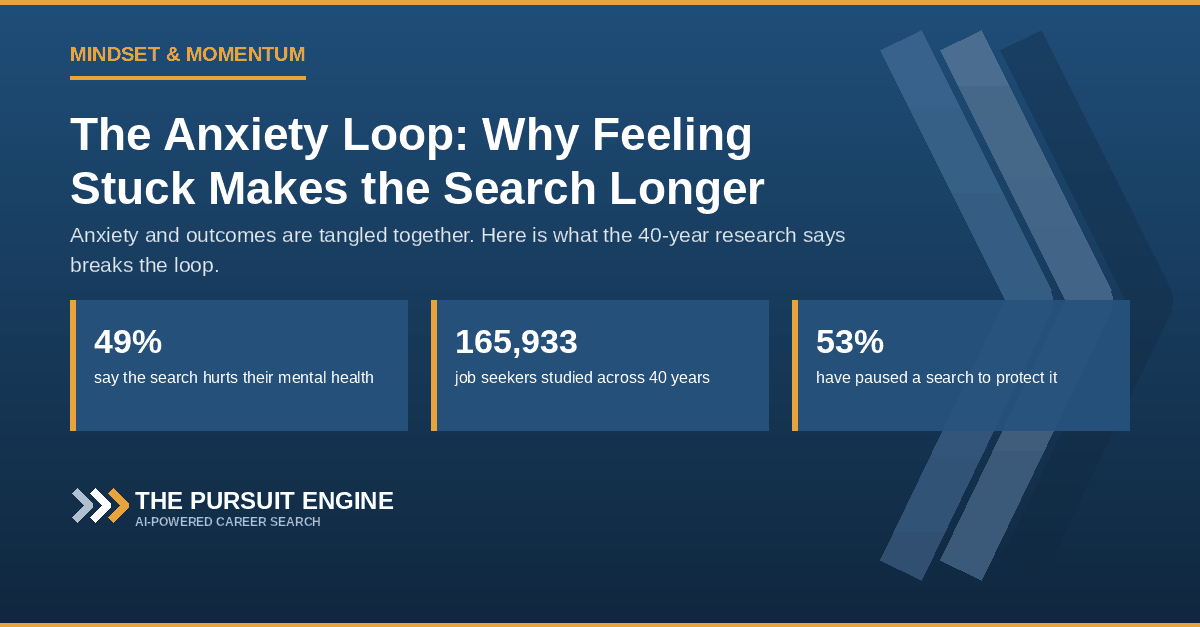
A 2026 survey of 1,000 U.S. job seekers, fielded through Pollfish in March and screened to confirm everyone was actively searching, found that 49% say job searching negatively affects their mental health. Only 13% report a positive effect. Among the people feeling the negative hit, the top drivers were rejections (47%), not hearing back at all (46%), financial pressure (45%), and difficulty staying motivated (45%). Separately, a Glassdoor poll of more than 1,300 professionals earlier this year found 53% of U.S. workers had paused a job search entirely to protect their mental health, and mentions of burnout in Glassdoor's own company reviews rose 65% year over year in the first quarter of 2026.
None of that surprised me, honestly. What stopped me was a much older and much larger piece of research that explains why it matters beyond just feeling bad.
Job search anxiety doesn't just feel worse. It's measurably tied to worse outcomes: rc = -.34 against employment quality, one of the strongest relationships in a review spanning four decades of research.
Want the version of this search that doesn't run on raw volume? See what a targeted package actually looks like.
Get 3 free roles →Four decades, 165,933 job seekers, one uncomfortable finding
In 2021, the Journal of Applied Psychology published a quantitative review pulling together 378 independent samples, drawn from research conducted between 1978 and 2019, covering 165,933 job seekers in total. It's one of the largest bodies of evidence we have on what actually predicts whether, and how well, someone lands a job. Buried in the findings: job search anxiety was negatively correlated with employment quality at rc = -.34, a notably strong relationship by the standards of this kind of research. In plain terms, the more anxious a search feels, the worse the eventual outcome tends to be, on average, across tens of thousands of people and forty years of data.
That's not a guilt-trip. It's the opposite of one. If the anxiety were just an unfortunate side effect with no bearing on the result, you could reasonably ignore it and grind through. The research says you can't, quite, because the anxiety and the outcome are tangled up in the same loop. Rejection and silence produce anxiety. Anxiety pushes people toward faster, more scattershot applications, or toward avoiding the search altogether. Both of those produce more rejection and silence. The loop feeds itself.
Why pausing isn't the failure it feels like
Given that loop, the 53% of professionals who told Glassdoor they'd paused a search to protect their mental health aren't quitting, they're doing something closer to rational risk management, even if it doesn't feel that way at 11pm. The same Glassdoor data found people now estimate they have roughly a 45% chance of landing a new role within three months, down sharply from more optimistic estimates in prior years, against a backdrop where the hiring rate has fallen to 3.3%, just half a point above the June 2009 low during the Great Recession, and the quits rate has dropped to 1.9%. People are reading the market correctly. Feeling worn down by it is not a personal defect, it's an accurate read of genuinely harder conditions.
The distinction that matters is between a short, deliberate pause and open-ended avoidance. Among job seekers managing burnout, Glassdoor found 28% already use a structured routine with a defined stop time each day as a coping mechanism, and 39% use a more selective application strategy rather than applying to everything in sight. Both of those show up independently in the academic research as things that predict better outcomes, not just better feelings. That's the part worth taking seriously: the coping mechanisms people reach for instinctively and the behaviors the research says work are, in this case, the same behaviors.
| What predicts a better outcome | Correlation to outcome |
|---|---|
| Job search self-efficacy → search quality | rc = .34 |
| Goal clarity → job search intensity | rc = .26 |
| Goal clarity → employment status | rc = .17 |
| Job search anxiety → employment quality | rc = -.34 |
What actually breaks the loop
The instinct when a search stalls is to apply to more things, faster. The research points the other way. In the same 2021 review, raw job search intensity, meaning sheer volume of applications, had a much weaker relationship to employment status (rc = .19) than job search quality did to the same outcome (rc = .18 to .19 as well, but arrived at through far fewer, more deliberate applications), and goal clarity on its own predicted employment status about as strongly as intensity did. The clearest predictor of search quality wasn't willpower or motivation, it was job search self-efficacy, essentially a person's confidence that their effort will actually work, which correlated with search quality at rc = .34, one of the strongest links in the whole review.
Put together, here's what that looks like in practice, not as a platitude but as a specific set of behaviors the data ties to better results:
- Narrow the target list on purpose. Goal clarity, meaning a specific, defined set of roles and companies rather than a vague sense of "anything in my field," predicted both search intensity and employment status. A shorter list you actually understand beats a long one you're applying to on autopilot.
- Put a stop time on the day. The 28% of burned-out job seekers already doing this in the Glassdoor data are, functionally, protecting their job search self-efficacy: an open-ended day where the search can expand to fill all your waking hours is a fast way to erode the confidence that predicts quality.
- Track quality, not volume. Count how many applications you actually tailored and could defend in an interview, not how many you sent. Volume without quality showed the weakest relationship to good outcomes in the entire review.
- Treat the anxiety as data, not a character flaw. If a search has started to feel like static, that's worth addressing directly, not pushing through silently, precisely because the research shows it's tied to the outcome, not separate from it.
Where this fits with what I tell clients
I built The Pursuit Engine after my own layoff from Lumen, and the thing I didn't expect going in was how much of the hard part wasn't finding roles, it was staying steady enough to apply well to the ones I found. The system exists to take the volume problem off a person's plate entirely, verified roles, tailored packages, one clear queue instead of an open-ended scroll, so the energy that's left can go toward the part that actually predicts a better outcome: a smaller number of applications done with real care, sent by someone who still has enough self-efficacy left to make them good.
If you've been telling yourself you should be able to push through the volume by sheer will, the data says that was never really the lever. Clarity, quality, and protecting your own steadiness were the lever the whole time.