The Gap They Don't Warn You About
Nobody tells you about the gap.
On July 1st, I was notified my job was impacted by a reduction in force. My last official day was July 10th. My insurance ran out 30 days after that. In the middle of it, I had a surgery scheduled, something I needed, not elective, something that's been causing me daily pain.
I did what you're supposed to do. I applied for Medicaid right away.
The hold, the drop, the denial
First came the hold. Four hours and fifteen minutes on one call, the same loop of elevator music, before the call itself just … failed. Dropped. No callback.
Then, after finally reaching someone, two more hours to get an actual answer: denied. The reason? I'm receiving $624 a week in unemployment. That's too much income to qualify.
The math that doesn't add up
I want to sit with that for a second, because it's not a fluke or a caseworker having a bad day. I looked it up.
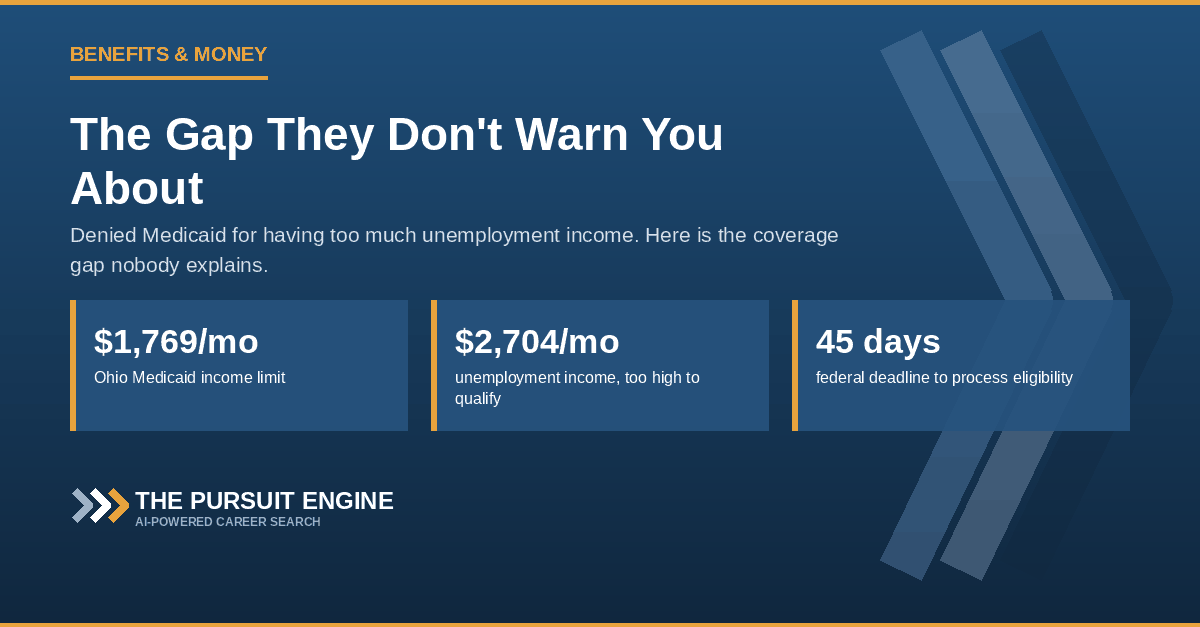
Ohio Medicaid's 2026 income limit for a single adult is 133% of the federal poverty level, $1,769 a month. My unemployment benefit comes out to roughly $2,704 a month. I am disqualified from the program meant to cover me while I'm out of work, because of the program that exists to keep me financially afloat while I'm out of work.
Two safety nets, built by two different sets of rules, that actively cancel each other out for people like me.
What the 45-day rule looks like from the inside
There's also a federal rule most people have never heard of: Medicaid agencies are required by law (42 CFR 435.912) to make an eligibility determination within 45 days of application for most cases. I don't know exactly how my timeline compares to that yet. But I know what it feels like from the inside: hours of hold music, a dropped call, and an answer that only came after I did the chasing.
Navigating a layoff is hard enough without doing it alone.
Get 3 free roles →COBRA was already off the table
By the time I got the denial, COBRA was already off the table too, the enrollment window had closed while I was waiting on hold. And even if it hadn't, the sticker price of COBRA for someone living on unemployment isn't a real option, it's a number designed for a paycheck I no longer have.
The window that's still open
The case manager who denied me did point me toward the ACA marketplace, and to be fair, that's probably the right next step. Losing employer coverage is a qualifying event, and there is a real window, 60 days after coverage ends, to enroll outside of open enrollment. I'm looking into that now.
But notice what just happened: I lost my job, lost my insurance, lost the COBRA window while waiting on hold, got denied by Medicaid for the crime of having unemployment income, and I am still, weeks later, the one doing all the navigating, all the paperwork, all the phone calls, while managing pain that hasn't gone away and a surgery that's still waiting.
The honest bottom line
Here's what nobody tells you when you lose a job: the layoff isn't the hard part. The hard part is everything after, when the income stops, the insurance countdown starts, and the "help" that's supposed to catch you is a maze with rules written by people who've never had to live inside them.
I think about how many people are going through exactly this right now, in more pain than I'm in, further from okay than I am, with less time and less support to fight through it. The system is supposed to be a safety net. Too often, it's a waiting room with bad music and a denial letter at the end of it.
I don't have a tidy ending yet, because I'm still in it. But if you're in this gap too, on hold, denied, waiting on a callback, I see you. You are not imagining how broken this is, and the numbers back you up. If you know someone going through a layoff right now, ask them how they're doing with coverage, not just the job search. It might be the harder problem.