The Job Was Never Real: What 2026's Ghost Job Data Actually Shows
Early in my own search after Lumen, I spent the better part of a week on a role that I later realized had been posted, in some form, for over four months. Same title, same description, reposted every few weeks like clockwork. I never heard back. I assumed I just wasn't a fit. I didn't yet have a name for what had actually happened: I'd applied to a ghost job, a posting that was never really going anywhere.
New 2026 data says that wasn't bad luck. It's close to the median experience right now.
Nearly half of job seekers have hit one this year
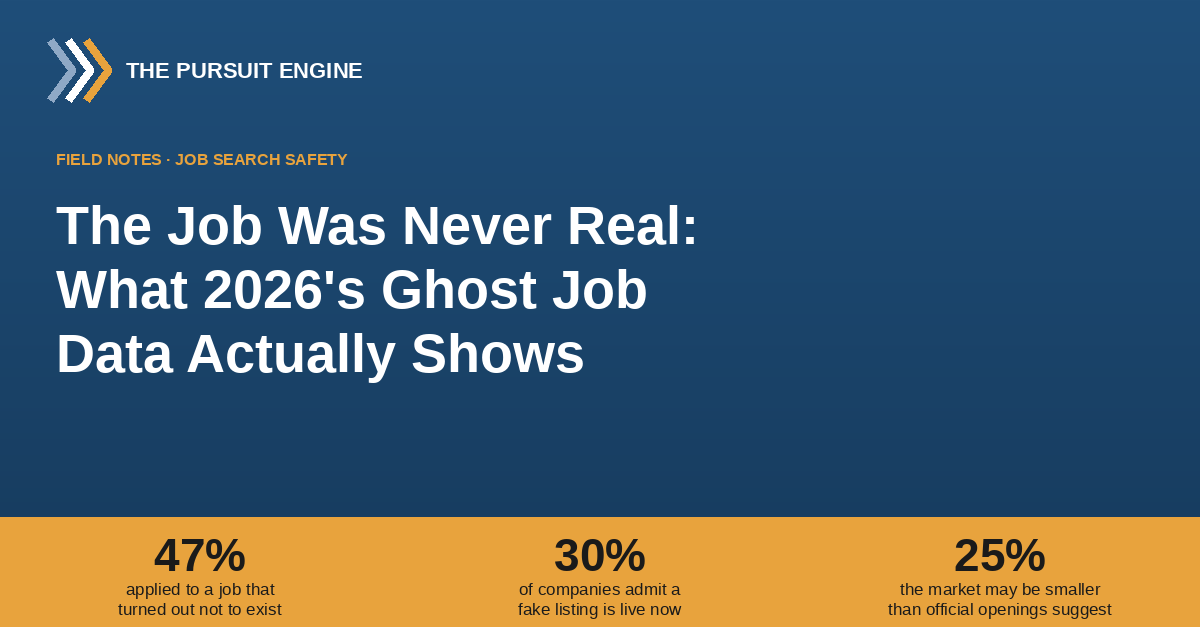
Enhancv surveyed 1,000 U.S. job seekers in March 2026 and found that 47% had applied to a role that later turned out not to exist at all, not filled by someone else, not cancelled after the fact, just never a real opening to begin with. A quarter of those people had already made it to an interview before finding out. More than a third reported spending real money pursuing a job that wasn't there: travel for an in-person interview, a skills assessment with a fee attached, a background check they paid for themselves.
A separate Resume Genius survey of 1,000 active job seekers, fielded the same month, found two-thirds (67%) suspected they'd encountered a fake, misleading, or already-filled posting. Among people with eight or more years of experience, Enhancv's data put the number even higher, 51%. This isn't a problem concentrated in entry-level roles getting flooded with applicants. It's showing up across the board, and showing up more the longer you've been working.
| Measure | 2026 figure | Source |
|---|---|---|
| Job seekers who applied to a role that didn't exist | 47% | Enhancv, 1,000 U.S. job seekers |
| Suspected encountering a fake/misleading posting | 67% | Resume Genius / Pollfish, 1,000 job seekers |
| Reached interview stage before discovering the role was fake | 25% | Enhancv |
| Companies with an active fake listing right now | 30% | ResumeBuilder.com / Pollfish, hiring managers |
Tired of guessing which postings are even real? I verify every role before it reaches you.
Get 3 free roles →Why companies post jobs they have no intention of filling
This part is what surprised me most when I actually read the employer-side research. A Pollfish survey of hiring managers, commissioned by ResumeBuilder.com, found that 40% of companies had posted a fake job listing in the past year, and 30% currently have at least one active. When asked why, the honest answers had almost nothing to do with hiring at all:
- 67% said it was to create the appearance of being open to outside talent, even when they weren't really looking.
- 66% said it was to project an image of company growth.
- 63% said it was meant to convince current employees that relief was coming, so workloads would feel more bearable.
- 62% said it was meant to make existing staff feel more replaceable.
- 59% said it was simply to collect and bank resumes for whenever a real opening eventually showed up.
A posting doesn't have to be a lie about a specific job to still be a lie. Sometimes it's a message aimed at your current employees, dressed up as an opening for you.
None of that is about the external candidate at all. You're not failing to get noticed. In a meaningful share of cases, you were never the audience the posting was written for.
The market may genuinely be smaller than the listings suggest
Enhancv also ran a comparison most job seekers never get to see: official BLS job-openings data for January 2026 against actual hires in the same categories. The gaps were wide. In information and technology, there were 192,000 openings reported against just 102,000 actual hires, a 46.8% gap. In education and health services, 1,595,000 openings against 802,000 hires, a 49.7% gap. Finance showed a 42.8% gap. Taken together, the analysis suggests the real, hireable job market may run roughly 25% smaller than the posted-openings figures imply, not because every one of those gaps is a ghost job specifically, but because inflated and duplicated postings are clearly part of what's padding the numbers.
That matters for how you read your own results. If your application-to-response ratio feels worse than it should, part of that may not be your materials at all. Part of the denominator you're applying against was never fully real.
How to spot one before you spend a week on it
None of these signs alone proves a posting is fake. Together, they're worth pausing on before you sink hours into a tailored application:
- It's been up for months with zero changes. A posting that's been live, identical, for 90+ days with no edits to requirements or salary is a common ghost-job pattern, especially for the same title reappearing on a cycle.
- The description is generic enough to fit almost any company. Real, urgent openings tend to have specific, recently-written detail. Recycled boilerplate is a yellow flag.
- Salary is missing or unrealistically wide. Resume Genius's respondents flagged this as one of the most common tells: 41% cited missing pay information and 45% cited an unrealistically high range as red flags they'd personally noticed.
- Total silence, including no auto-acknowledgment, for two to three weeks. Most real pipelines move faster than that for at least the first response, even an automated one.
- The same title keeps reopening at the same company. If a role gets reposted every few weeks indefinitely, that's a resume-pipeline pattern, not an active search.
Lawmakers are starting to take this seriously too. As of mid-2026, legislatures in Pennsylvania, New Jersey, New York, California, and Kentucky all have bills pending that would require companies to disclose whether a posting reflects a genuinely open role, with penalties for leaving stale listings up after a position is filled. None of it is law yet, which means for now, the burden of spotting a ghost job still sits with you.
It shouldn't. But until it changes, the fix isn't to apply to fewer jobs out of suspicion. It's to spend your limited hours on the roles that show real signs of life, and stop quietly blaming yourself for the ones that never had any.