The Two Kinds of AI Job Seeker (Only One Gets More Offers)
Someone on a call with me last week said, half-joking, "I feel like I'm losing to a robot." Turns out she's more right than she knew, just not in the way she meant. She isn't losing to AI. She's losing to other job seekers who are using AI a specific, deliberate way, while she's using it the way most people default to. Those are two very different things, and the data on the gap between them is bigger than I expected.
The number that stopped me
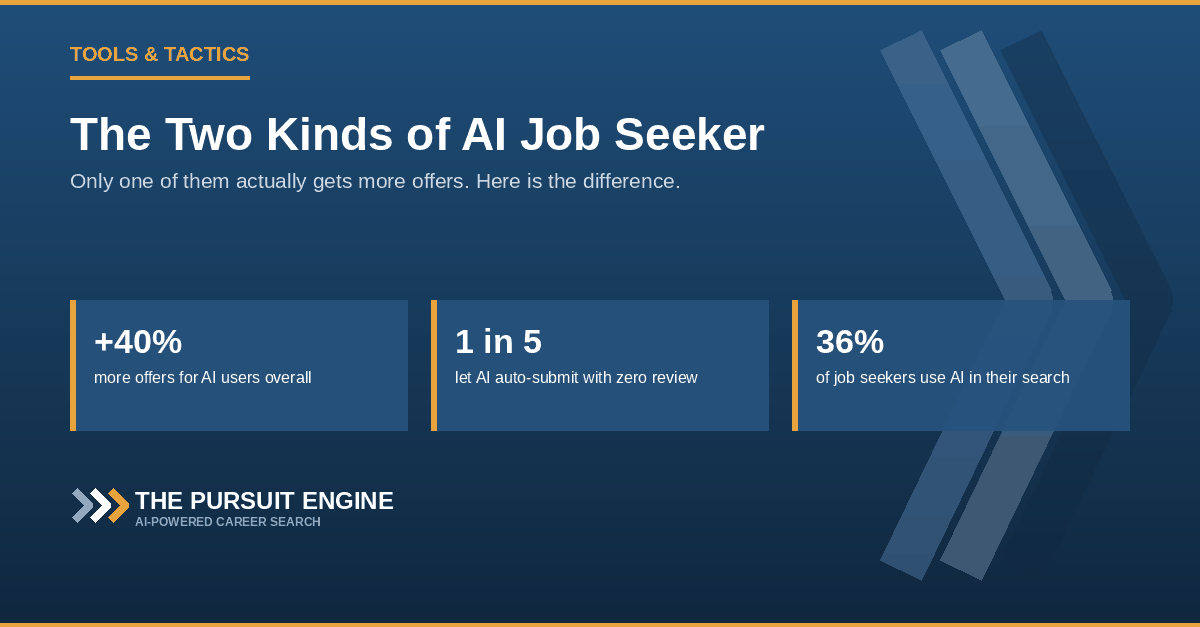
A study of 500 U.S. job seekers published in August, fielded by Gdoc.io through the survey platform Pollfish, found that people who used AI anywhere in their search received 40% more job offers overall than people who didn't use it at all. Broken down further: 65.9% of AI users landed at least one offer, against 46.7% of non-users. AI users were more than twice as likely to land two or more offers, 48% versus 22.7%. And only 9.5% of AI users went through the whole search without a single interview, compared to 30% of people who skipped AI entirely.
That's a real gap, not a rounding error. If I stopped there, the takeaway would be simple: use AI, get better results. But that's not actually what the data says, and the part underneath it is the part worth sitting with.
36% of job seekers now use AI in their search. Not all 36% are getting the 40% bump. Some of them are getting quietly filtered out by the exact same tool.
Want a package built the way this article says actually works, tailored to one real role, not a template blasted everywhere?
Get 3 free roles →The split that actually decides the outcome
Buried in the same study is the number that explains the paradox: 20% of AI-using job seekers let AI automatically submit applications for them, with no human review before it goes out. Nearly 80% of AI-assisted job seekers are using a general-purpose tool like ChatGPT, not something purpose-built for tailoring a specific application to a specific posting. Put those two facts together and you get a predictable outcome: some of the "AI users" in that 36% are producing fast, generic, keyword-stuffed applications at volume, which is precisely the pattern that ATS filters and tired human reviewers are both trained to spot and discard.
Meanwhile, more than half, 54.2%, said they'd never disclose to an employer that they used AI at all. There's no settled norm yet on disclosure, and honestly, I don't think disclosure is the real question. The real question a hiring manager is asking, consciously or not, is simpler: does this read like it was written for me, specifically, or does it read like it was written for anyone.
AI can help you write something that reads like it was written specifically for one role and one reader. It can also help you write two hundred applications in an afternoon that all read like they were written for no one. Same tool. Opposite outcome. The 40% gap in offers isn't AI versus no AI. It's tailored versus templated, and AI happens to make both dramatically faster to produce.
What this looks like against the hiring math right now
It helps to see this against what employers are actually dealing with on their side. A 2026 hiring benchmark report from iCIMS and Nucleus Research, surveying over 1,000 talent acquisition leaders, found applicants per posting ranging from about 88 in hospitality up to 196 in finance, depending on industry, with offer-acceptance rates holding steady in the mid-to-upper 70s across the board once an offer is actually extended.
| Group | Got at least 1 offer | Got 2+ offers |
|---|---|---|
| Used AI in search | 65.9% | 48% |
| Did not use AI | 46.7% | 22.7% |
When a hiring manager is sorting through 88 to nearly 200 applications for one opening, the applications that survive the first cut are the ones that are unmistakably about that role. In a pool that crowded, a generic AI-drafted application isn't neutral, it's actively worse than a plainer, more specific human one, because it reads like the fifty other generic AI-drafted applications sitting next to it.
What good AI use actually looks like
This is the exact problem I built The Pursuit Engine to solve after I was laid off from Lumen. I didn't want AI to help me apply to more things faster. I wanted it to help me go deeper on fewer things: verify a posting is actually live before I spend an evening on it, pull the specific language a company uses to describe the role, and build a resume and cover letter that speaks to that one opening instead of a generic version of my whole career. A few things that separate that kind of AI use from the auto-submit kind:
- A human reads it before it goes out, every time. The 20% auto-submit rate is the single riskiest number in this whole study. If you never read the final draft, you have no way of knowing whether it's specific or generic, and neither does the person reading it on the other end.
- Feed it the actual posting, not a vague prompt. "Write me a cover letter for a marketing manager job" produces the generic version. Pasting in the real posting, the company's own language, and one or two specifics about why this role and this company, produces something that reads like it was written for a person.
- Use it to go narrower, not wider. The instinct with any efficiency tool is to do more with it. In a market with 88 to 196 applicants per posting, more untargeted applications is close to the worst use of the time AI just freed up. Spend the saved time on fewer, sharper ones instead.
- Verify before you tailor. A beautifully tailored application to a role that's a ghost posting or already spoken for internally is still wasted effort. AI can help you write faster. It can't tell you whether a posting is real, that still takes a human checking.
The honest bottom line
The 40% gap in offers is real, but it isn't a story about AI being magic. It's a story about what AI gets used for. The job seekers pulling ahead aren't the ones applying to the most roles, they're the ones using the time AI saves them to go deeper on fewer roles instead of wider on more of them. If you're one of the 36% already using AI in your search, the question worth asking isn't whether to keep using it. It's whether what it's producing would survive you reading it out loud to the actual hiring manager's face.