The Warm Path: Why Referred Candidates Get Hired Up to 7x More Often (and Why Almost Nobody Uses It Right)
A client told me last month that she'd rather cold-apply to two hundred more jobs than send one more "hey, it's been a while" message to a former coworker. "It feels like begging," she said. I understood it. I also had to tell her the data says that discomfort is costing her real interviews, not saving her dignity.
Here's the tension worth sitting with: the single most effective lever in a job search right now is also the one job seekers trust the least. That gap, not a lack of open roles, is what's actually keeping a lot of good candidates stuck.
What job seekers believe versus what hiring managers actually do
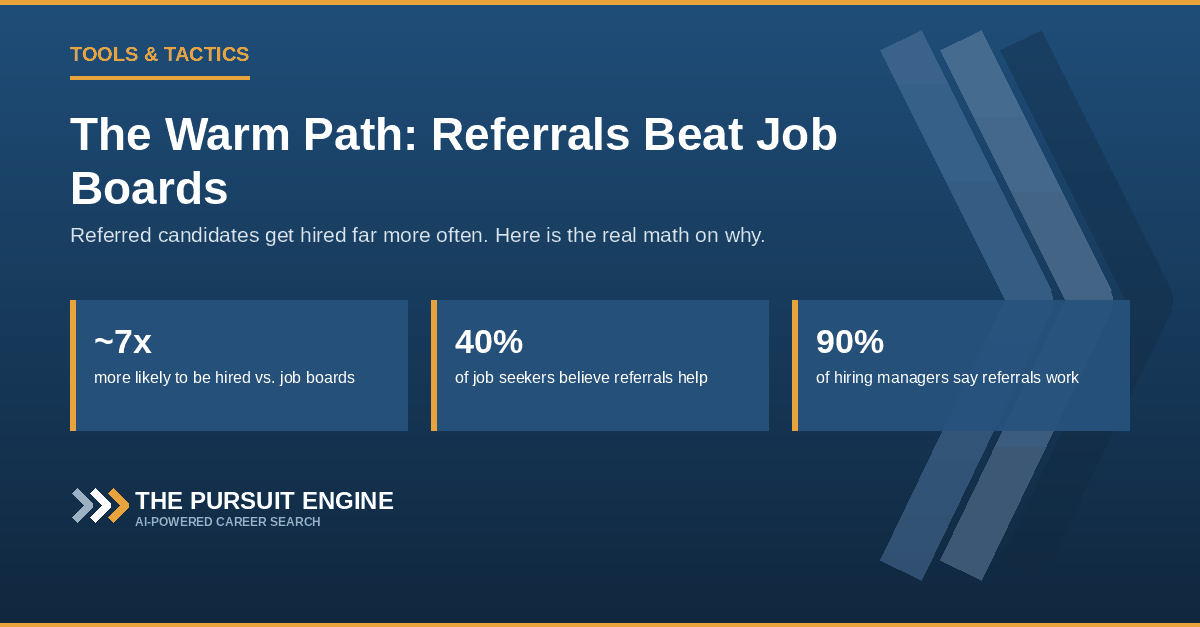
An Express Employment Professionals-Harris Poll released in April 2026, drawing on a survey of 1,003 U.S. adults and a separate survey of 1,002 U.S. hiring decision-makers, found only 40% of job seekers believe a referral actually helps them stand out. Less than half.
On the other side of the same poll, hiring managers tell a very different story. 90% said referrals make hiring more efficient. 80% said they prioritize interviewing a referred candidate over an equally qualified applicant with no connection to anyone inside. 76% said referred employees perform better once hired. The people making the decision believe in this lever far more than the people who could be pulling it.
The gap isn't access. Most people already know someone who could make an introduction. The gap is belief, and belief is what determines whether you actually ask.
Want someone else to map the warm paths into your target roles for you?
Get 3 free roles →What "better odds" actually looks like in numbers
Pinpoint, a hiring platform, ran an analysis across 4.5 million job applications and found referred candidates were about 7 times more likely to be hired than applicants who came in through a job board, rising to roughly 11 times more likely in logistics and supply chain roles specifically. Separately, National University's 2026 hiring statistics report puts referrals at only around 7% of total applicants, but 30% to 50% of actual hires. A small slice of the applicant pool is closing a wildly outsized share of the jobs.
| Metric | Referral | Non-referral |
|---|---|---|
| Apply-to-hire conversion rate | 28.2% | 2%–5% |
| Likelihood of being hired vs. job boards | ~7x (up to 11x in logistics) | baseline |
| Share of applicants | ~7% | ~93% |
| Share of actual hires | 30%–50% | 50%–70% |
The apply-to-hire conversion figures come from referral-platform data compiled in Hellora's 2026 "State of Employee Referral Programs" report, which also found referral hires close roughly 10 days faster than hires sourced any other way. None of these numbers come from the same study, and estimates move around depending on industry and company size. But every dataset I could find this year points the same direction, by a wide enough margin that it stops looking like noise.
Why so few people actually use it
Research cited by Apollo Technical, drawing on HubSpot data, found one in four professionals does not network at all, and among the ones who say they value it, only 48% keep consistent contact with their network between job searches. Most people's networks go quiet the moment they're not needed, then get reactivated the moment they are, which is exactly the pattern that makes an ask feel like begging instead of a normal conversation.
The same Harris Poll that found only 40% of job seekers trust referrals also asked hiring managers what makes them wary of vouching for someone. 68% said they're less likely to provide a reference if the person only reaches out when they need something. 66% said they specifically weigh whether the relationship was maintained before agreeing to help. The discomfort my client described is real, and the poll suggests it's not irrational, it's a sign the ask arrived at the wrong time in the relationship, not that the relationship itself was wrong to lean on.
What actually works
A few things that changed how I coach clients through this, once the data made it clear how much this one lever is worth:
- Reconnect before you need anything. A message that starts with a real question about their work, months before you're job searching, is what makes the eventual ask feel like a normal continuation instead of a cold reactivation.
- Ask for something specific, not vague goodwill. "Could you introduce me to whoever's hiring for the ops role on your team" gets a yes far more often than "let me know if you hear of anything," because it gives the other person a concrete, low-effort action instead of an open-ended favor.
- The referral doesn't need to come from someone senior. It needs to come from someone who will actually say your name out loud in a room you're not in. A peer two years into a company is often more useful than an executive you met once.
- Treat "I don't have a strong network" as a solvable problem, not a fixed trait. A former manager, a old client, a person from a professional group you haven't opened in a year, these usually count. The bar for a warm path is lower than it feels from the outside.
This is also, plainly, part of why I build warm-path research into every search I run rather than leaving it to chance, because the data above is exactly why the shortest distance to an offer usually runs through a person, not a portal.
The honest bottom line
The data doesn't say cold applications never work, plenty of people still get hired that way. It says the odds shift hard, by a factor of several times over, the moment a real person is willing to put their name near yours. Most job seekers already have more of that available to them than they believe, they just haven't reactivated it, or haven't asked for something specific enough to make it easy to say yes. That's a fixable gap. It's just not the gap most people are working on.